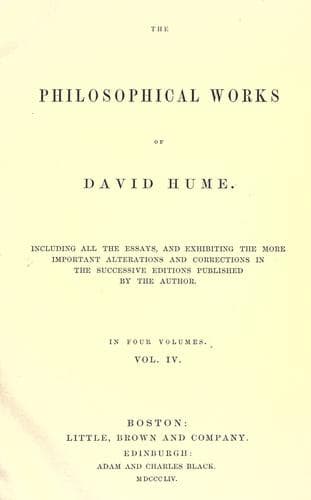
Philosophical Works, v. 1 (of 4): Including All the Essays, and Exhibiting the More Important Alterations and Corrections in the Successive Editions Published by the Author — John Shaqi
Philosophical Works, v. 1 (of 4): Including All the Essays, and Exhibiting the More Important Alterations and Corrections in the Successive Editions Published by the AuthorHume, David
PhilosophyPhilosophy
Philosophical Works, v. 1 (of 4): Including All the Essays, and Exhibiting the More Important Alterations and Corrections in the Successive Editions Published by the Author
Hume, David
Knowledge, Theory of; Philosophy, English -- 18th century
In 1752, the Faculty of Advocates chose me their Librarian, an office
from which I received little or no emolument, but which gave me the
command of a large library. I then formed the plan of writing the
History of England; but being frightened with the notion of continuing
a narrative through a period of 1700 years, I commenced with the
accession of the House of Stuart, an epoch when, I thought, the
misrepresentations of faction began chiefly to take place. I was, I
own, sanguine in my expectations of the success of this work. I thought
that I was the only historian that had at once neglected present
power, interest, and authority, and the cry of popular prejudices; and
as the subject was suited to every capacity, I expected proportional
applause. But miserable was my disappointment: I was assailed by one
cry of reproach, disapprobation, and even detestation; English, Scotch,
and Irish, Whig and Tory, Churchman and Sectary, Free-thinker and
Religionist, Patriot and Courtier, united in their rage against the
man, who had presumed to shed a generous tear for the fate of Charles
I. and the Earl of Strafford; and after the first ebullitions of their
fury were over, what was still more mortifying, the book seemed to sink
into oblivion. Mr Millar told me, that in a twelvemonth he sold only
forty-five copies of it. I scarcely, indeed, heard of one man in the
three kingdoms, considerable for rank or letters, that could endure the
book. I must only except the primate of England, Dr Herring, and the
primate of Ireland, Dr Stone, which seem two odd exceptions. These
dignified prelates separately sent me messages not to be discouraged.
I was however, I confess, discouraged; and had not the war been at that
time breaking out between France and England, I had certainly retired
to some provincial town of the former kingdom, have changed my name,
and never more have returned to my native country. But as this scheme
was not now practicable, and the subsequent volume was considerably
advanced, I resolved to pick up courage, and to persevere.
In this interval, I published at London my Natural History of Religion,
along with some other small pieces. Its public entry was rather
obscure, except only that Dr Hurd wrote a pamphlet against it, with all
the illiberal petulance, arrogance and scurrility, which distinguish
the Warburtonian school. This pamphlet gave me some consolation for the
otherwise indifferent reception of my performance.
In 1756, two years after the fall of the first volume, was published
the second volume of my History, containing the period from the death
of Charles I. till the Revolution. This performance happened to give
less displeasure to the Whigs, and was better received. It not only
rose itself, but helped to buoy up its unfortunate brother.
Public-domain text, read in full here on John Shaqi.
Reviews
Reviews
No reviews yet
Be the first to share your thoughts on this work.
Join the Discussion
Join the discussion
Sign in to leave a comment or review.
Sign InorCreate an account