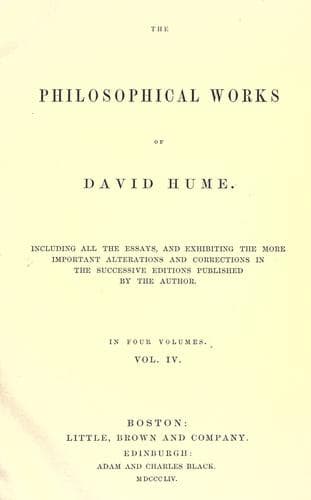
Philosophical Works, v. 1 (of 4): Including All the Essays, and Exhibiting the More Important Alterations and Corrections in the Successive Editions Published by the AuthorHume, David
PhilosophyPhilosophy
Philosophical Works, v. 1 (of 4): Including All the Essays, and Exhibiting the More Important Alterations and Corrections in the Successive Editions Published by the Author
Hume, David
Knowledge, Theory of; Philosophy, English -- 18th century
Cry him Call him
To crave To dun, to ask payment
To get a stomach To get an appetite
Vacance Vacation
A TREATISE OF HUMAN NATURE.
BEING AN ATTEMPT TO INTRODUCE THE
EXPERIMENTAL METHOD OF
REASONING INTO
MORAL SUBJECTS.
RARA TEMPORUM FELICITAS, UBI SENTIRE, QUÆ VELIS;
ET QUÆ SENTIAS, DICERE LICET.
TACITUS.
BOOK I.
OF THE UNDERSTANDING.
_ADVERTISEMENT._
_My design in the present Work is sufficiently explained in the
Introduction. The reader must only observe, that all the subjects I
have there planned out to myself are not treated in these two volumes.
The subjects of the Understanding and Passions make a complete chain
of reasoning by themselves; and I was willing to take advantage of
this natural division, in order to try the taste of the Public. If I
have the good fortune to meet with success, I shall proceed to the
examination of Morals, Politics, and Criticism, which will complete
this Treatise of Human Nature. The approbation of the Public I consider
as the greatest reward of my labours; but am determined to regard its
judgment, whatever it be, as my best instruction._
INTRODUCTION.
Nothing is more usual and more natural for those, who pretend to
discover any thing new to the world in philosophy and the sciences,
than to insinuate the praises of their own systems, by decrying all
those which have been advanced before them. And indeed were they
content with lamenting that ignorance, which we still lie under in the
most important questions that can come before the tribunal of human
reason, there are few, who have an acquaintance with the sciences, that
would not readily agree with them. 'Tis easy for one of judgment and
learning, to perceive the weak foundation even of those systems, which
have obtained the greatest credit, and have carried their pretensions
highest to accurate and profound reasoning. Principles taken upon
trust, consequences lamely deduced from them, want of coherence in the
parts, and of evidence in the whole, these are every where to be met
with in the systems of the most eminent philosophers, and seem to have
drawn disgrace upon philosophy itself.
Public-domain text, read in full here on John Shaqi.
Reviews
Reviews
No reviews yet
Be the first to share your thoughts on this work.
Elsewhere in the archive
Join the Discussion
Join the discussion
Sign in to leave a comment or review.
Sign InorCreate an account