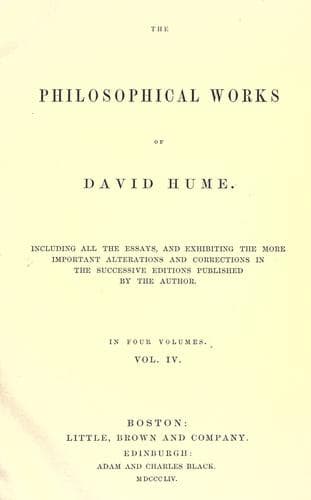
Philosophical Works, v. 1 (of 4): Including All the Essays, and Exhibiting the More Important Alterations and Corrections in the Successive Editions Published by the AuthorHume, David
PhilosophyPhilosophy
Philosophical Works, v. 1 (of 4): Including All the Essays, and Exhibiting the More Important Alterations and Corrections in the Successive Editions Published by the Author
Hume, David
Knowledge, Theory of; Philosophy, English -- 18th century
Nor is there required such profound knowledge to discover the present
imperfect condition of the sciences, but even the rabble without doors
may judge from the noise and clamour which they hear, that all goes
not well within. There is nothing which is not the subject of debate,
and in which men of learning are not of contrary opinions. The most
trivial question escapes not our controversy, and in the most momentous
we are not able to give any certain decision. Disputes are multiplied,
as if every thing was uncertain. Amidst all this bustle, 'tis not
reason which carries the prize, but eloquence; and no man needs ever
despair of gaining proselytes to the most extravagant hypothesis, who
has art enough to represent it in any favourable colours. The victory
is not gained by the men at arms, who manage the pike and the sword,
but by the trumpeters, drummers, and musicians of the army.
From hence, in my opinion, arises that common prejudice against
metaphysical reasonings of all kinds, even amongst those who profess
themselves scholars, and have a just value for every other part of
literature. By metaphysical reasonings, they do not understand those
on any particular branch of science, but every kind of argument which
is any way abstruse, and requires some attention to be comprehended.
We have so often lost our labour in such researches, that we commonly
reject them without hesitation, and resolve, if we must for ever be
a prey to errors and delusions, that they shall at least be natural
and entertaining. And, indeed, nothing but the most determined
scepticism, along with a great degree of indolence, can justify this
aversion to metaphysics. For, if truth be at all within the reach
of human capacity, 'tis certain it must lie very deep and abstruse;
and to hope we shall arrive at it without pains, while the greatest
geniuses have failed with the utmost pains, must certainly be esteemed
sufficiently vain and presumptuous. I pretend to no such advantage
in the philosophy I am going to unfold, and would esteem it a strong
presumption against it, were it so very easy and obvious.
Public-domain text, read in full here on John Shaqi.
Reviews
Reviews
No reviews yet
Be the first to share your thoughts on this work.
Elsewhere in the archive
Join the Discussion
Join the discussion
Sign in to leave a comment or review.
Sign InorCreate an account