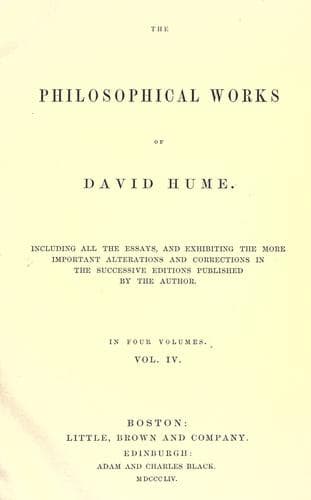
Philosophical Works, v. 1 (of 4): Including All the Essays, and Exhibiting the More Important Alterations and Corrections in the Successive Editions Published by the AuthorHume, David
PhilosophyPhilosophy
Philosophical Works, v. 1 (of 4): Including All the Essays, and Exhibiting the More Important Alterations and Corrections in the Successive Editions Published by the Author
Hume, David
Knowledge, Theory of; Philosophy, English -- 18th century
The idea of a substance as well as that of a mode, is nothing but
a collection of simple ideas, that are united by the imagination,
and have a particular name assigned them, by which we are able to
recal, either to ourselves or others, that collection. But the
difference betwixt these ideas consists in this, that the particular
qualities, which form a substance, are commonly referred to an unknown
_something_, in which they are supposed to inhere; or granting this
fiction should not take place, are at least supposed to be closely and
inseparably connected by the relations of contiguity and causation.
The effect of this is, that whatever new simple quality we discover to
have the same connexion with the rest, we immediately comprehend it
among them, even though it did not enter into the first conception of
the substance. Thus our idea of gold may at first be a yellow colour,
weight, malleableness, fusibility; but upon the discovery of its
dissolubility in _aqua regia_, we join that to the other qualities, and
suppose it to belong to the substance as much as if its idea had from
the beginning made a part of the compound one. The principle of union
being regarded as the chief part of the complex idea, gives entrance to
whatever quality afterwards occurs, and is equally comprehended by it,
as are the others, which first presented themselves.
That this cannot take place in modes, is evident from considering their
nature. The simple ideas of which modes are formed, either represent
qualities, which are not united by contiguity and causation, but are
dispersed in different subjects; or if they be all united together,
the uniting principle is not regarded as the foundation of the complex
idea. The idea of a dance is an instance of the first kind of modes;
that of beauty of the second. The reason is obvious, why such complex
ideas cannot receive any new idea, without changing the name, which
distinguishes the mode.
SECTION VII.
OF ABSTRACT IDEAS.
A very material question has been started concerning _abstract_ or
_general_ ideas, _whether they be general or particular in the mind's
conception of them_. A great philosopher[3] has disputed the received
opinion in this particular, and has asserted, that all general ideas
are nothing but particular ones annexed to a certain term, which gives
them a more extensive signification, and makes them recal upon occasion
other individuals, which are similar to them. As I look upon this to be
one of the greatest and most valuable discoveries that has been made
of late years in the republic of letters, I shall here endeavour to
confirm it by some arguments, which I hope will put it beyond all doubt
and controversy.
Public-domain text, read in full here on John Shaqi.
Reviews
Reviews
No reviews yet
Be the first to share your thoughts on this work.
Elsewhere in the archive
Join the Discussion
Join the discussion
Sign in to leave a comment or review.
Sign InorCreate an account