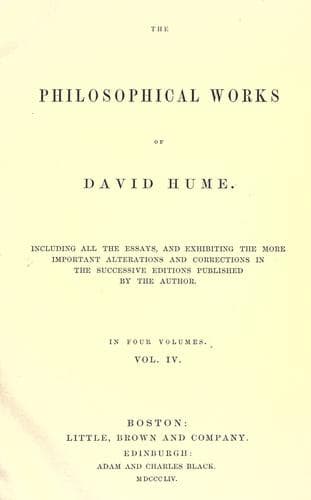
Philosophical Works, v. 1 (of 4): Including All the Essays, and Exhibiting the More Important Alterations and Corrections in the Successive Editions Published by the AuthorHume, David
PhilosophyPhilosophy
Philosophical Works, v. 1 (of 4): Including All the Essays, and Exhibiting the More Important Alterations and Corrections in the Successive Editions Published by the Author
Hume, David
Knowledge, Theory of; Philosophy, English -- 18th century
5. When any two objects possess the same _quality_ in common, the
_degrees_ in which they possess it form a fifth species of relation.
Thus, of two objects which are both heavy, the one may be either of
greater or less weight than the other. Two colours, that are of the
same kind, may yet be of different shades, and in that respect admit of
comparison.
6. The relation of _contrariety_ may at first sight be regarded as
an exception to the rule, _that no relation of any kind can subsist
without some degree of resemblance_. But let us consider, that no
two ideas are in themselves contrary, except those of existence and
non-existence, which are plainly resembling, as implying both of them
an idea of the object; though the latter excludes the object from all
times and places, in which it is supposed not to exist.
7. All other objects, such as fire and water, heat and cold, are only
found to be contrary from experience, and from the contrariety of their
_causes_ or _effects_; which relation of cause and effect is a seventh
philosophical relation, as well as a natural one. The resemblance
implied in this relation shall be explained afterwards.
It might naturally be expected that I should join _difference_ to the
other relations; but that I consider rather as a negation of relation
than as any thing real or positive. Difference is of two kinds, as
opposed either to identity or resemblance. The first is called a
difference of _number_; the other of _kind_.
SECTION VI.
OF MODES AND SUBSTANCES.
I would fain ask those philosophers, who found so much of their
reasonings on the distinction of substance and accident, and imagine we
have clear ideas of each, whether the idea of _substance_ be derived
from the impressions of sensation or reflection? If it be conveyed
to us by our senses, I ask, which of them, and after what manner? If
it be perceived by the eyes, it must be a colour; if by the ears, a
sound; if by the palate, a taste; and so of the other senses. But I
believe none will assert, that substance is either a colour, or sound,
or a taste. The idea of substance must therefore be derived from an
impression of reflection, if it really exist. But the impressions of
reflection resolve themselves into our passions and emotions; none
of which can possibly represent a substance. We have, therefore, no
idea of substance, distinct from that of a collection of particular
qualities, nor have we any other meaning when we either talk or reason
concerning it.
Public-domain text, read in full here on John Shaqi.
Reviews
Reviews
No reviews yet
Be the first to share your thoughts on this work.
Elsewhere in the archive
Join the Discussion
Join the discussion
Sign in to leave a comment or review.
Sign InorCreate an account