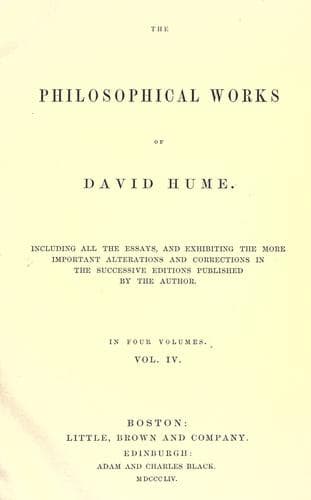
Philosophical Works, v. 1 (of 4): Including All the Essays, and Exhibiting the More Important Alterations and Corrections in the Successive Editions Published by the AuthorHume, David
PhilosophyPhilosophy
Philosophical Works, v. 1 (of 4): Including All the Essays, and Exhibiting the More Important Alterations and Corrections in the Successive Editions Published by the Author
Hume, David
Knowledge, Theory of; Philosophy, English -- 18th century
however it may be made to represent others which have different degrees
of both.
Secondly, 'tis confessed, that no object can appear to the senses; or
in other words, that no impression can become present to the mind,
without being determined in its degrees both of quantity and quality.
The confusion, in which impressions are sometimes involved, proceeds
only from their faintness and unsteadiness, not from any capacity in
the mind to receive any impression, which in its real existence has
no particular degree nor proportion. That is a contradiction in terms;
and even implies the flattest of all contradictions, viz. that 'tis
possible for the same thing both to be and not to be.
Now, since all ideas are derived from impressions, and are nothing but
copies and representations of them, whatever is true of the one must be
acknowledged concerning the other. Impressions and ideas differ only in
their strength and vivacity. The foregoing conclusion is not founded on
any particular degree of vivacity. It cannot, therefore, be affected by
any variation in that particular. An idea is a weaker impression; and,
as a strong impression must necessarily have a determinate quantity and
quality, the case must be the same with its copy or representative.
Thirdly, 'tis a principle generally received in philosophy, that every
thing in nature is individual, and that 'tis utterly absurd to suppose
a triangle really existent, which has no precise proportion of sides
and angles. If this, therefore, be absurd in _fact and reality_, it
must also be absurd _in idea_; since nothing of which we can form a
clear and distinct idea is absurd and impossible. But to form the
idea of an object, and to form an idea simply, is the same thing; the
reference of the idea to an object being an extraneous denomination, of
which in itself it bears no mark or character. Now, as 'tis impossible
to form an idea of an object that is possessed of quantity and quality,
and yet is possessed of no precise degree of either, it follows, that
there is an equal impossibility of forming an idea, that is not limited
and confined in both these particulars. Abstract ideas are, therefore,
in themselves individual, however they may become general in their
representation. The image in the mind is only that of a particular
object, though the application of it in our reasoning be the same as if
it were universal.
Public-domain text, read in full here on John Shaqi.
Reviews
Reviews
No reviews yet
Be the first to share your thoughts on this work.
Elsewhere in the archive
Join the Discussion
Join the discussion
Sign in to leave a comment or review.
Sign InorCreate an account