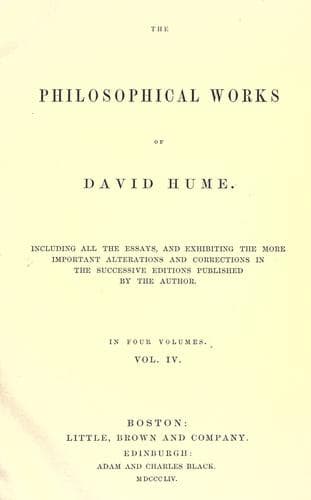
Philosophical Works, v. 1 (of 4): Including All the Essays, and Exhibiting the More Important Alterations and Corrections in the Successive Editions Published by the AuthorHume, David
PhilosophyPhilosophy
Philosophical Works, v. 1 (of 4): Including All the Essays, and Exhibiting the More Important Alterations and Corrections in the Successive Editions Published by the Author
Hume, David
Knowledge, Theory of; Philosophy, English -- 18th century
This application of ideas, beyond their nature, proceeds from our
collecting all their possible degrees of quantity and quality in
such an imperfect manner as may serve the purposes of life, which is
the second proposition I proposed to explain. When we have found a
resemblance[4] among several objects, that often occur to us, we apply
the same name to all of them, whatever differences we may observe
in the degrees of their quantity and quality, and whatever other
differences may appear among them. After we have acquired a custom of
this kind, the hearing of that name revives the idea of one of these
objects, and makes the imagination conceive it with all its particular
circumstances and proportions. But as the same word is supposed to have
been frequently applied to other individuals, that are different in
many respects from that idea, which is immediately present to the mind;
the word not being able to revive the idea of all these individuals,
only touches the soul, if I may be allowed so to speak, and revives
that custom, which we have acquired by surveying them. They are not
really and in fact present to the mind, but only in power; nor do we
draw them all out distinctly in the imagination, but keep ourselves in
a readiness to survey any of them, as we may be prompted by a present
design or necessity. The word raises up an individual idea, along
with a certain custom, and that custom produces any other individual
one, for which we may have occasion. But as the production of all the
ideas, to which the name may be applied, is in most cases impossible,
we abridge that work by a more partial consideration, and find but few
inconveniences to arise in our reasoning from that abridgment.
For this is one of the most extraordinary circumstances in the present
affair, that after the mind has produced an individual idea, upon
which we reason, the attendant custom, revived by the general or
abstract term, readily suggests any other individual, if by chance we
form any reasoning that agrees not with it. Thus, should we mention
the word triangle, and form the idea of a particular equilateral
one to correspond to it, and should we afterwards assert, _that
the three angles of a triangle are equal to each other_, the other
individuals of a scalenum and isosceles, which we overlooked at first,
immediately crowd in upon us, and make us perceive the falsehood of
this proposition, though it be true with relation to that idea which
we had formed. If the mind suggests not always these ideas upon
occasion, it proceeds from some imperfection in its faculties; and
such a one as is often the source of false reasoning and sophistry.
But this is principally the case with those ideas which are abstruse
and compounded. On other occasions the custom is more entire, and 'tis
seldom we run into such errors.
Public-domain text, read in full here on John Shaqi.
Reviews
Reviews
No reviews yet
Be the first to share your thoughts on this work.
Elsewhere in the archive
Join the Discussion
Join the discussion
Sign in to leave a comment or review.
Sign InorCreate an account