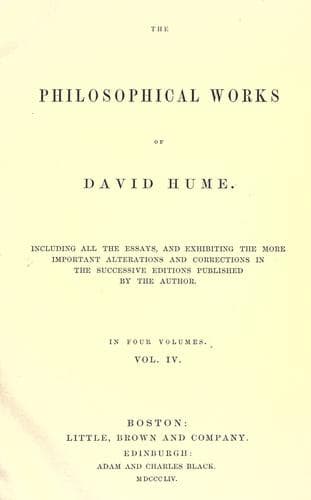
Philosophical Works, v. 1 (of 4): Including All the Essays, and Exhibiting the More Important Alterations and Corrections in the Successive Editions Published by the AuthorHume, David
PhilosophyPhilosophy
Philosophical Works, v. 1 (of 4): Including All the Essays, and Exhibiting the More Important Alterations and Corrections in the Successive Editions Published by the Author
Hume, David
Knowledge, Theory of; Philosophy, English -- 18th century
We may hence discover the error of the common opinion, that the
capacity of the mind is limited on both sides, and that 'tis impossible
for the imagination to form an adequate idea of what goes beyond a
certain degree of minuteness as well as of greatness. Nothing can be
more minute than some ideas which we form in the fancy, and images
which appear to the senses; since there are ideas and images perfectly
simple and indivisible. The only defect of our senses is, that they
give us disproportioned images of things, and represent as minute and
uncompounded what is really great and composed of a vast number of
parts. This mistake we are not sensible of; but, taking the impressions
of those minute objects, which appear to the senses to be equal,
or nearly equal to the objects, and finding, by reason, that there
are other objects vastly more minute, we too hastily conclude, that
these are inferior to any idea of our imagination or impression of
our senses. This, however, is certain, that we can form ideas, which
shall be no greater than the smallest atom of the animal spirits of
an insect a thousand times less than a mite: and we ought rather to
conclude, that the difficulty lies in enlarging our conceptions so much
as to form a just notion of a mite, or even of an insect a thousand
times less than a mite. For, in order to form a just notion of these
animals, we must have a distinct idea representing every part of them;
which, according to the system of infinite divisibility, is utterly
impossible, and according to that of indivisible parts or atoms, is
extremely difficult, by reason of the vast number and multiplicity of
these parts.
SECTION II.
OF THE INFINITE DIVISIBILITY OF SPACE AND TIME.
Wherever ideas are adequate representations of objects, the relations,
contradictions, and agreements of the ideas are all applicable to the
objects; and this we may, in general, observe to be the foundation of
all human knowledge. But our ideas are adequate representations of
the most minute parts of extension; and, through whatever divisions
and subdivisions we may suppose these parts to be arrived at, they
can never become inferior to some ideas which we form. The plain
consequence is, that whatever _appears_ impossible and contradictory
upon the comparison of these ideas, must be _really_ impossible and
contradictory, without any farther excuse or evasion.
Public-domain text, read in full here on John Shaqi.
Reviews
Reviews
No reviews yet
Be the first to share your thoughts on this work.
Elsewhere in the archive
Join the Discussion
Join the discussion
Sign in to leave a comment or review.
Sign InorCreate an account