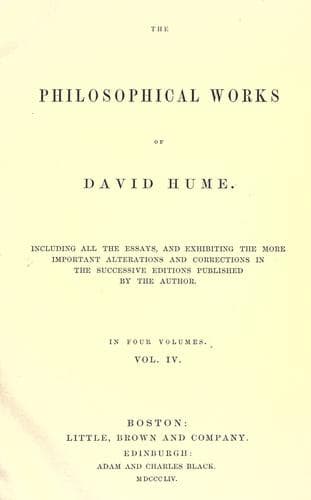
Philosophical Works, v. 1 (of 4): Including All the Essays, and Exhibiting the More Important Alterations and Corrections in the Successive Editions Published by the AuthorHume, David
PhilosophyPhilosophy
Philosophical Works, v. 1 (of 4): Including All the Essays, and Exhibiting the More Important Alterations and Corrections in the Successive Editions Published by the Author
Hume, David
Knowledge, Theory of; Philosophy, English -- 18th century
'Tis universally allowed, that the capacity of the mind is limited, and
can never attain a full and adequate conception of infinity: and though
it were not allowed, 'twould be sufficiently evident from the plainest
observation and experience. 'Tis also obvious, that whatever is capable
of being divided _in infinitum_, must consist of an infinite number
of parts, and that 'tis impossible to set any bounds to the number
of parts without setting bounds at the same time to the division. It
requires scarce any induction to conclude from hence, that the _idea_,
which we form of any finite quality, is not infinitely divisible, but
that by proper distinctions and separations we may run up this idea
to inferior ones, which will be perfectly simple and indivisible. In
rejecting the infinite capacity of the mind, we suppose it may arrive
at an end in the division of its ideas; nor are there any possible
means of evading the evidence of this conclusion.
'Tis therefore certain, that the imagination reaches a _minimum_,
and may raise up to itself an idea, of which it cannot conceive
any subdivision, and which cannot be diminished without a total
annihilation. When you tell me of the thousandth and ten thousandth
part of a grain of sand, I have a distinct idea of these numbers and
of their different proportions; but the images which I form in my mind
to represent the things themselves, are nothing different from each
other, nor inferior to that image, by which I represent the grain of
sand itself, which is supposed so vastly to exceed them. What consists
of parts is distinguishable into them, and what is distinguishable is
separable. But, whatever we may imagine of the thing, the idea of a
grain of sand is not distinguishable nor separable into twenty, much
less into a thousand, ten thousand, or an infinite number of different
ideas.
'Tis the same case with the impressions of the senses as with the ideas
of the imagination. Put a spot of ink upon paper, fix your eye upon
that spot, and retire to such a distance that at last you lose sight
of it; 'tis plain, that the moment before it vanished, the image, or
impression, was perfectly indivisible. 'Tis not for want of rays of
light striking on our eyes, that the minute parts of distant bodies
convey not any sensible impression; but because they are removed
beyond that distance, at which their impressions were reduced to a
_minimum_, and were incapable of any farther diminution. A microscope
or telescope, which renders them visible, produces not any new rays of
light, but only spreads those which always flowed from them; and, by
that means, both gives parts to impressions, which to the naked eye
appear simple and uncompounded, and advances to a _minimum_ what was
formerly imperceptible.
Public-domain text, read in full here on John Shaqi.
Reviews
Reviews
No reviews yet
Be the first to share your thoughts on this work.
Elsewhere in the archive
Join the Discussion
Join the discussion
Sign in to leave a comment or review.
Sign InorCreate an account