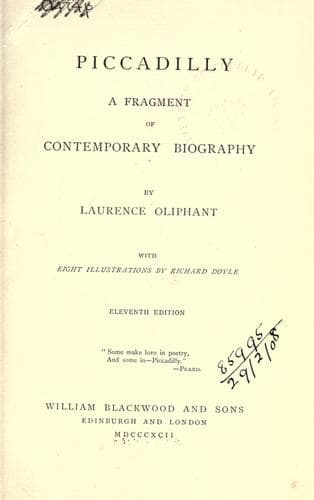
Piccadilly: A Fragment of Contemporary BiographyOliphant, Laurence
General
Piccadilly: A Fragment of Contemporary Biography
Oliphant, Laurence
Piccadilly (London, England) -- Fiction
"Because modern Christians don't really believe much more than
sceptics--a man's life is the result of his internal, not his external
belief. There can be no life separate from internal belief, and the
lives of men are imperfect because their belief is external. The right
thing believed the right way must inevitably produce the perfect life.
Either, then, the civilised world believes the wrong thing, or it
believes the right thing the wrong way. In other words, faith and
charity are inseparable, and when one is perfect the other is too. That
is what I mean by 'living the life.'"
"According to that, you would make out that nobody rightly believes the
Christian religion who is not perfect; that, you know, is ridiculous,"
said Broadhem.
"That is, nevertheless, exactly what I do mean. To know the doctrine, it
is necessary to do the will. Christians of the present day adopt certain
theological dogmas intellectually and call them their religious belief.
This has a superficial and varying influence upon their lives, for it
consists merely of opinions which are liable to change. The only kind of
faith which is inseparable from life is a divine conviction of truth
imparted to the intellect through the heart, and which becomes as
absolute to the internal conscience as one's existence, and as
impossible of proof. It may be added to, but what has once been thus
accepted can never be changed. Such a faith cannot be selfish, for it
has been derived from the affections, hence the life must be charitable.
But the modern Christian belief, received by an effort of pure reason
directly through the intellect, is not a divine intuition, which, if
embodied, would result in a perfect life and a united Church, but a
theological problem which professors of religion, unlike professors of
mathematics, are at liberty to solve for their own benefit, according to
their own taste, and to quarrel about incessantly, thereby giving
occasion to the thoughtless to scoff, and to the thoughtful to reject
all revelation as 'foolishness'--since it is incapable of demonstration
by the Baconian method,--the only one known to these 'wise and prudent'
philosophers, but one by which, fortunately for them, 'babes' are not
expected to prove their relationship before believing in their mothers."
"Then," said Broadhem, "you actually mean to say that the whole of
Christendom is wanting in this faith?"
Public-domain text, read in full here on John Shaqi.
Reviews
Reviews
No reviews yet
Be the first to share your thoughts on this work.
Elsewhere in the archive
Join the Discussion
Join the discussion
Sign in to leave a comment or review.
Sign InorCreate an account