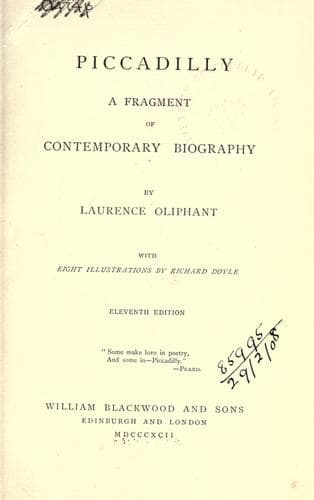
Piccadilly: A Fragment of Contemporary BiographyOliphant, Laurence
General
Piccadilly: A Fragment of Contemporary Biography
Oliphant, Laurence
Piccadilly (London, England) -- Fiction
"I fear that almost universally they mistake a bare belief for faith.
Their theology thus becomes an _act_ of memory instead of a rule of
life, and Christianity is reduced to a superstition. The only way of
distinguishing superstition from true religion is by an examination of
results. But where are the fruits of modern Christianity? If it be
absolutely true, and all-sufficient for purposes of regeneration, how am
I to account for the singular fact that there is as much wickedness in
London in the year 1865 A.D., as there was in Jerusalem in the year 1
B.C.? If the object of the last revelation was to take the place of the
one before it, and to reform the world, why are the best modern
Christians of my acquaintance no holier than the best modern Jews whom I
have the honour to know?"
"But the object of the last revelation was not to reform the world, but
to save it," he replied.
"Thanks, Broadhem, for having put in rather too epigrammatic a form,
perhaps, to please those who believe it, the most diabolical sophism
that was ever invented to beguile a Church--the doctrine that men can be
saved by opinion without practice: that a man's practice may be bad, and
yet because his faith is good his salvation is sure--that he can, by
such a miserable philosophy as would disgrace the justice of the earth,
escape the just sentence to be passed upon all his deeds. The results of
so fatal a dogma must be a Church that tends to atheism, and that loves
corruption. There is in every heart a something that speaks against
this, and speaks with a burning language that sweeps the invisible
chords of the inmost consciousness, and awakens a torrent of indignant
denial of the shallow sophistry that a man can be saved if his thoughts
and life are bad. If he cherish self-love, and the love of ruling
others, though he intrench the intellect in the midst of all creeds, and
span the reason with all faiths, making a sacred public profession
before all men, he but adds to the heinousness of his crime, and makes
more terrible the fast-coming and final judgment."
Broadhem stopped suddenly in the street as I finished in a somewhat
excited tone, and gasped rather than spoke, "Frank, you literally
astound me. I could never have believed it possible you would have come
out in that line. Are those your own ideas or another's?"
"Another's," I replied, coolly. "I believe they are rather unsound, but
I commend them to your notice, because, if they are not correct,
Christianity will soon cease to exist, even in name; but if they are,
then it contains within it a regenerating power hitherto undeveloped,
whereby the world may be absolutely reformed. I will venture to assert
that Christian nations will make no moral progress so long as they
continue to cherish the pagan superstition that religion consists in
trying to save themselves by virtue of a creed, instead of in trying to
save others by the virtues of a life."
"But that's works," said Broadhem.
Public-domain text, read in full here on John Shaqi.
Reviews
Reviews
No reviews yet
Be the first to share your thoughts on this work.
Elsewhere in the archive
Join the Discussion
Join the discussion
Sign in to leave a comment or review.
Sign InorCreate an account