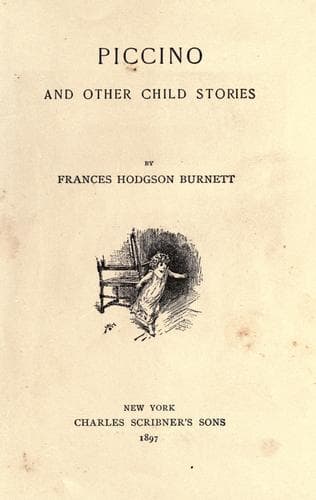
Piccino, and other child storiesBurnett, Frances Hodgson
General
Piccino, and other child stories
Burnett, Frances Hodgson
Children -- Conduct of life -- Juvenile fiction; Children's stories, American
But there was just one thing that gave him a homely feeling. And oh!
he felt it so good that it was so! As they turned in at the gate he
heard a familiar sound. It was the hysteric sniffing and jumping and
yelping whines of welcome of a dog—a poor, exiled doggie, whose kennel
was kept close by the gate, probably to guard it. He was fastened by a
chain, and evidently, being a friendly, sociable creature, did not like
being kept in this lonely place and not allowed to roam with the world.
He could not have friendly fights and associates, and he could not rush
about and jump on ladies’ dresses and gentlemen’s clothes and leave his
dusty or muddy affectionate paw-marks all over them. And so he was not
happy, and when he heard footsteps approaching always strained at his
chain, and sniffed and whined. As these returning carriages belonged to
his own domestic circle he almost went wild with joy, and leaped and
yelped and did his best to make somebody speak to him. He was adoringly
fond of Lady Aileen, who scarcely ever noticed him at all, but once
or twice had said “Good fellow! Nice dog!” as she went by, and once
had come and looked at him and given him two whole pats, while he had
wriggled and fawned himself nearly into hysterics of dog delight.
And so it happened that as the carriage turned into the beautiful
gateway Piccino heard this sound he knew—that loving, eager, pleading
dog voice, which is as much Italian as it is English, and as much
peasant as it is noble. The dogs in the hovels near Ceriani spoke just
as Lady Aileen’s dog did, and asked for just the same thing—that human
things should love them a little and believe that they themselves love
a great deal. And Piccino, who was only a beautiful little baby animal
himself, understood it vaguely, and was somehow reminded of his friend
the donkey, and felt not quite so many hundred miles from home and the
tumble-down stable and Maria. He involuntarily lifted his soft, dirty,
blooming face to Greggs in the dark.
“_A chi il cane?_” he said. (Whose dog is that?)
“What’s that he’s saying?” said Greggs to the coachman.
“Must be something about the dog,” answered Hepburn. “He said something
or other about a carney, and carney means dog. It’s a deuce of a
language to make out.”
And so, not being answered, Piccino could only resign himself, and, as
the carriage rolled up the drive, listen to the familiar homely dog
sound and wish he could get down and go to the kennel. And then the
carriage stopped before the door. And the door was thrown open by a
liveried servant, and showed the brilliantly lighted hall, where there
were beautiful pictures and ornaments, and curious things hung on
the walls, and rich rugs on the floor, and quaint seats and bits of
furniture about, so that to Piccino it looked like a grand room.
Lady Aileen spoke to the footman at the door.
“Send Nicholson to me,” she said. “Bring the child into the hall,” she
said to Greggs.
Public-domain text, read in full here on John Shaqi.
Reviews
Reviews
No reviews yet
Be the first to share your thoughts on this work.
Join the Discussion
Join the discussion
Sign in to leave a comment or review.
Sign InorCreate an account