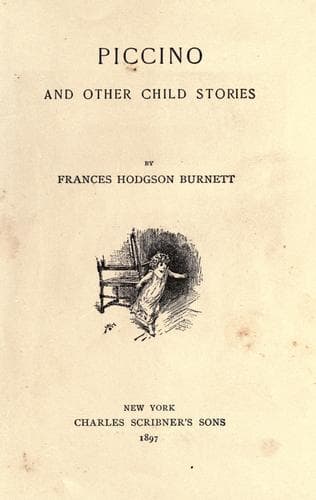
Piccino, and other child storiesBurnett, Frances Hodgson
General
Piccino, and other child stories
Burnett, Frances Hodgson
Children -- Conduct of life -- Juvenile fiction; Children's stories, American
When sometimes he spoke of them to such of his playmates as were older
than himself—especially to Carlo, who tended sheep, and was afraid
of nothing, even making jokes about the _forestieri_—they said they
thought he had been foolish; that as it seemed that the people had been
ready to give him anything, it could not have been so bad but one could
have tried to bear it, though they all agreed that it was dreadful
about the water.
It is true, too, that as he grew older himself, after his mother died
and his father married again—the big Paula who flew into such rages and
beat him—and when he had to tend sheep and goats himself, and stay
out on the hills all day in such ragged jackets and with so little
food—because Paula said he had not earned his salt, and she had her own
children to feed—then he longed for some of the food he would not eat
during those two days, and wondered if he would do quite the same thing
again under the same circumstances. But this was only when he was very
hungry and the mistral was blowing, and the Mediterranean looked gray
instead of blue.
He was such a tiny fellow when it happened. He was not yet six years
old, and when a child is under six he has not reached the age when
human creatures have begun to face life for themselves altogether;
and even a little Italian peasant, who tumbles about among sheep and
donkeys, which form part of his domestic circle, is still in a measure
a sort of baby, whose mother or brother or sister has to keep an
occasional eye on him to see that he does not kill himself. And then
also Piccino had been regarded by his family as a sort of capital, and
had consequently had more attention paid to him than he would have had
under ordinary circumstances.
It was like this. He was so pretty, so wonderfully pretty! His
brothers and sisters were not beauties, but he was a beauty from his
first day, and with every day that passed he grew prettier. When
he was so tiny that he was packed about like a bundle, wound up in
unattractive-looking bandages, he had already begun to show what his
eyes were going to be—his immense soft black eyes, with lashes which
promised to be velvet fringes. And as soon as his hair began to show
itself, it was lovely silk, which lay in rings, one over the other, on
his beautiful little round head. Then his soft cheeks and chin were of
exquisite roundness, and in each he had a deep dimple which came and
went as he laughed.
He was always being looked at and praised. A “_Gesù bambino_” the
peasant women called him. That was what they always said when a child
had wonderful beauty, their idea of supreme child loveliness being
founded on the pictures and waxen, richly dressed figures they saw in
the churches.
Public-domain text, read in full here on John Shaqi.
Reviews
Reviews
No reviews yet
Be the first to share your thoughts on this work.
Join the Discussion
Join the discussion
Sign in to leave a comment or review.
Sign InorCreate an account