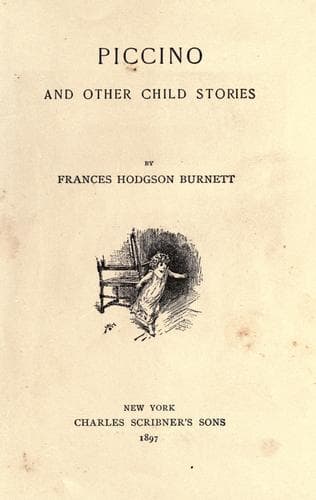
Piccino, and other child storiesBurnett, Frances Hodgson
General
Piccino, and other child stories
Burnett, Frances Hodgson
Children -- Conduct of life -- Juvenile fiction; Children's stories, American
And then they took him back to the villa—the poor dog leaping and
straining at his chain by which he was fastened again when they passed
the gate—and his face and hands were washed once more, and his hair
combed, and he was given more strange things for dinner. A solid
underdone English chop without sauce seemed a horrible thing to him,
and nursery rice pudding filled him with amazement. He stared at the
big potato Nicola put on his plate, and wondered if he was to be made
to starve.
“Goodness, what does the child want?” exclaimed Nicholson. “I am sure
he has never had such a dinner set before him before.”
That was exactly it. He had lived on things so different that this
substantial nursery food quite revolted him.
He thought of himself only as a prisoner. He began to feel empty and
furious. He was possessed by but one thought—how he could get away.
In the afternoon he was dressed again—in another girl’s frock and sash
and lace collar—and a lot of ladies and gentlemen came to see Lady
Aileen. Her five-o’clock teas were very popular, and this afternoon
every one wanted to see the child she had picked up at Ceriani. People
were always curious about her whims. So Piccino was talked about and
examined and laughed over as the most charming of jokes, and the more
he hung back and pouted the more he was laughed at, until his cheeks
were crimson all the time, and he would not eat the cakes people kept
giving him, just as they would have fed a parrot to make it talk, or a
poodle to make it play tricks.
“He seems rather a sulky child,” said Lady Aileen, “and he evidently
detests civilization. He thought Nicholson was going to drown him, and
fought like a little tiger when she put him in his bath. The watch-dog
broke loose and came and slept with him last night. He has hardly eaten
anything to-day. I wonder if one could civilize him.”
While all the gay people were drinking tea and chocolate, and eating
cakes in the _salon_, and sauntering in groups among the flowers on
the terrace, some strolling musicians came into the grounds. A man and
woman and some children, who played guitars and mandolins and sang
peasant songs, seeing the bright dresses and hearing the voices, were
attracted by them. At such places they often got money.
When they began to play and sing Piccino ran to the window. They sang
as the people at Ceriani did, and he was wild to see them. When he
saw them he wanted to get near them. There was a boy, who sang with
the father and mother, and a girl about the age of Maria, who was not
singing. It was she who went round to beg for money, and she stood
aside, calmly munching a piece of black bread. She had other pieces of
something tied in her apron, and she looked so like Maria did when she
had begged something good, that Piccino’s mouth watered and a bold idea
came to him.
Everybody was so busy amusing themselves that for a while he was
forgotten. He glanced furtively about him, and slipped out of a side
door.
Public-domain text, read in full here on John Shaqi.
Reviews
Reviews
No reviews yet
Be the first to share your thoughts on this work.
Join the Discussion
Join the discussion
Sign in to leave a comment or review.
Sign InorCreate an account