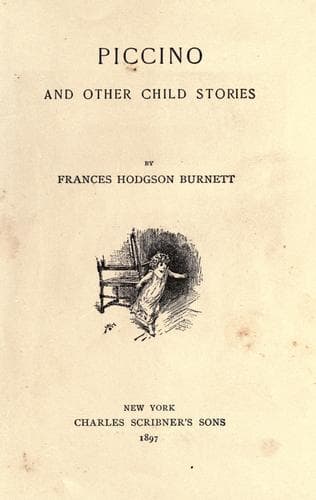
Piccino, and other child storiesBurnett, Frances Hodgson
General
Piccino, and other child stories
Burnett, Frances Hodgson
Children -- Conduct of life -- Juvenile fiction; Children's stories, American
“Let us take him in the cart as far as we go,” said Alessandro. “He
can find his way home after we leave him. Perhaps he will talk to us
about his Maria. She may be prettier than the other one.” And so he
was lifted into the cart, and the dog trotted joyfully by the donkey’s
side. The two probably talked to each other confidentially, and
everything was explained between them as far as the dog could explain
it. At all events, he could explain the loneliness of living in a
kennel with a chain round your neck, and grand people passing you,
laughing and talking, and taking no notice, however much you jumped and
whined and begged to have a pat and a word, and not seeing that you
loved everybody.
Piccino sat in the cart and leaned against Pietro or the boy, and
enjoyed himself. He answered questions about Maria, and did not
know why his rescuers laughed at everything he said. Maria seemed a
very mature person to him, and he did not know that the young men’s
impression that she was a pretty young woman was not the correct one.
Pietro had some good things he had brought from the _festa_ in a paper,
and he gave him some. That he was such a pretty, soft, rabbit-like
little thing, made things pleasant for him even when he was picked
up from the roadside by two young peasants full of cheap wine. They
laughed at his disconnected babbling, and thought him great fun, and
when he was sleepy let him cuddle down and be comfortable.
He was very fast asleep when they wakened him, having reached the end
of their journey.
“Here!” they said, shaking him good-naturedly enough, “you can find
your way to Maria now.”
He stood unsteadily in the road where Pietro put him, rubbing his eyes,
and feeling the dog greeting him again by jumping at him and kissing
him.
“Where is Maria?” he said, sleepily.
Pietro and Alessandro were sleepy too by this time; they had almost had
time to forget him while he was asleep.
“Go on and you will find her,” they said. “Ceriani is near here.”
When he saw the donkey led away Piccino was on the point of crying
because he was to be left, but before he quite began he saw by the
light of the moon, which had risen since he fell asleep, a familiar
tree—a big-twisted and huge-trunked olive he had sat under many a time
when he had strayed down the road with Maria. It made his heart begin
to beat fast and his rising tears dry in their fountain. It was true!
He was near Ceriani! He was near home! He could find it! He began to
run as fast as his short legs could carry him. The white villa and the
grand _signori_ who had joked about him all day, the bathtub and Nicola
and the dreadful _pasta_, seemed as far away now as Ceriani and the
donkey had been this morning. The tears that had dried for joy suddenly
began to rise again for joy. He did not know anything about it himself,
but it was joy which made him begin to choke—this beautiful little
savage peasant who had been taken away to a world so much too grand for
him.
Public-domain text, read in full here on John Shaqi.
Reviews
Reviews
No reviews yet
Be the first to share your thoughts on this work.
Join the Discussion
Join the discussion
Sign in to leave a comment or review.
Sign InorCreate an account