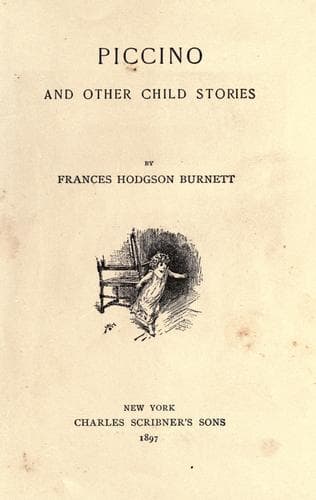
Piccino, and other child storiesBurnett, Frances Hodgson
General
Piccino, and other child stories
Burnett, Frances Hodgson
Children -- Conduct of life -- Juvenile fiction; Children's stories, American
So the captain and Miss Rosie began life on love and short commons;
and, neither of them understanding economy, made a good many mistakes,
as might have been expected. They didn’t know how to contrive, and they
got into debt, and when the children came and expenses grew heavier
they lost spirit and patience, like a good many more, and let things
go their own way. The captain lost his temper and the mistress
grew careless and fretted, and when the young master was born—the one
as I’m telling about—things were about as bad and as comfortless as
they could be. Not wishing to say a disrespectful word, or a harmful
one, I _must_ say as I’d even thought the captain were getting tired
of his love-match, for he was aging uncommon fast and his temper was
getting uncommon sharp, and now and then Mrs. Dalgetty and him would
have words, as would end in him striding out of the bungalow, leaving
her crying and worriting among the children. I can’t say even as he
were over fond of the children, or that they were over welcome when
they came—six girls, one after another—though they were pretty little
things, all of them. But when Master Lionel were born it struck me as
he _were_ rather better pleased than he had been before, for he were
the first boy.
Well I remember the day the captain came out of his quarters and told
me about his having made his appearance rather unexpected.
I had been so long with them, and there were so many little things I
could do as was a help, that I’d got into the way of doing them; and
I happened this morning to be polishing about, and sees the captain
coming out, looking half-way pleased with something or other; and when
I drew myself up and saluted as usual, says he:
“Rabbett,” says he, “there’s a change in the programme this time.”
I drops my swab in a minute and draws up and salutes again.
“What, sir?” says I. “Boy, sir?”
“Yes,” says he. “Boy, and a fine little fellow too.”
So in the course of a week I smartens myself up a bit more than common,
in honor of the occasion, and goes into the house and gets the ayah to
let me have a look at the young gentleman as he lay in his cradle in
the nursery, next to the mistress’s room. They was rather fond of me in
that nursery, I may say, and it wasn’t the first time I’d been there
by many a one. But though I stepped light enough for fear of wakening
the little fellow, somehow or other he did waken that very minute. As
I bent over his cradle he opens his eyes, and he actually stares at me
as if he was asking me a question or so. At least it looked that way to
me, and then, as sure as I’m a living man, he does something with his
face as if he was doing his best to laugh; and when I laughs back and
lifts his bit of a red hand, he opens it out and lets it lay on mine,
quite friendly and sociable.
Public-domain text, read in full here on John Shaqi.
Reviews
Reviews
No reviews yet
Be the first to share your thoughts on this work.
Join the Discussion
Join the discussion
Sign in to leave a comment or review.
Sign InorCreate an account