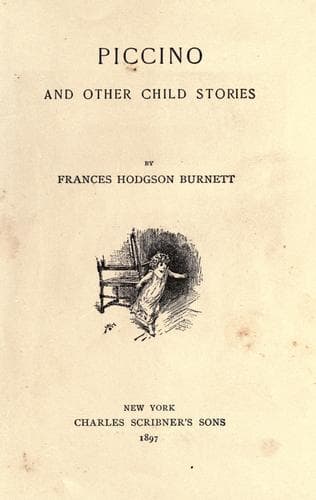
Piccino, and other child storiesBurnett, Frances Hodgson
General
Piccino, and other child stories
Burnett, Frances Hodgson
Children -- Conduct of life -- Juvenile fiction; Children's stories, American
“Rabbett,” says he to me once, when they was all going out—he was about
nine years old then, or thereabout—“Rabbett, if you would like to see
Rose before she goes, just stand in the passage, when I go into the
drawing-room with her cloak and handkerchief. She has just sent me for
them.”
Now my young master loved his mother dearly, but he loved Rose even
better; he was allers talking to me of her beauty.
So says I, “I would like to see her.” And he runs up-stairs, quite
pleased, and is down again in a minute.
“I’ll leave the door open,” he says. And in he goes, with the cloak
over his arm, and does leave it open, quite wide enough for me to see
through.
Miss Rose was standing by the fire, and beautiful she looked, in her
grand evening dress, and so like what her mother had been that it gave
me quite a start. There was a gentleman at her side, a-laughing and
talking to her, and when Master Lionel goes in this party turns toward
the door, to look at him, and I sees his face, and I gives a start
again, for it were Captain Basil Roscoe.
Now I knew sum’at of Captain Basil Roscoe, you see, and that’s what
made me give a start. If ever there was a villain, and he to be called
a gentleman, Captain Basil Roscoe were one. I knew things of him that
he little guessed; we servants get to know many queer things. I felt,
when I sees him, as if I saw a snake.
“Here comes the wrap,” says Captain Basil, and he held out his hand, as
if he meant to put it on for himself, but Miss Rose laughs and stops
him.
“No,” says she. “Lionel wouldn’t like that. Would you, Lionel? He
always puts my cloak on for me.”
The captain drew back a bit, and gave the boy a sharp glance, but Miss
Rose did not see it, for she was bending down to have the cloak put
over her white shoulders, and Master Lionel was a-folding it around
her, as pleased as could be, laughing, too, boy-like, but, for all
that, doing it as deft and graceful as if he’d been born to it.
And then, when it was done, Miss Rose put her little hands on the
shoulders of his jacket, and kissed him half-a-dozen times, so coaxing
and merry and happy that I could not bear to think the time would ever
come when life would look harder to her than it did just then—going out
to a grand ball, in a pretty dress, and with her lover by her side.
Unless it is true that the devil shrinks from and hates them as has no
sins of their own, I should like to know why it was that Basil Roscoe
were so ready in taking a dislike to a innocent-faced boy, as never
harmed or differed with him; for nothing is more certain than that from
the first he did take a dislike to Master Lionel. It struck me, once or
twice, as he not only couldn’t bear the sight of him, but that, if he
had had the chance, he would not have been sorry to do him a harm. His
sneering manner showed it, and his ill-looking, handsome face showed
it, apart from a hundred other bits of things. Master Lionel himself
found it out soon enough.
Public-domain text, read in full here on John Shaqi.
Reviews
Reviews
No reviews yet
Be the first to share your thoughts on this work.
Join the Discussion
Join the discussion
Sign in to leave a comment or review.
Sign InorCreate an account