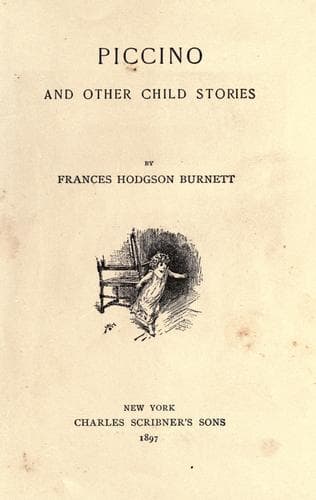
Piccino, and other child storiesBurnett, Frances Hodgson
General
Piccino, and other child stories
Burnett, Frances Hodgson
Children -- Conduct of life -- Juvenile fiction; Children's stories, American
I think I must have looked upset, myself, when I knocked at Miss Rose’s
door to deliver the captain’s message, for the minute the words were
out of my mouth she turned quite pale and scared-looking, and began to
tremble.
“Oh, Rabbett,” she says, the tears coming into her great, pretty dark
eyes, “is anything the matter? does he look angry?”
“I must say, miss,” I answers, “as he seems a bit more pepperyer than
common, but I hope it’s nothing much.”
“Oh, Rabbett,” she says, beginning to cry, and wringing her poor little
helpless hands, “I know it is something dreadful. I daren’t go down. I
am so frightened.”
But she were obliged to go down, and go down she did, a-trembling all
over, and out-and-out faint with fear. She had always been a timid
little affectionate creature, and the captain were pretty hard to face
when his temper were up.
I am not ashamed to confess as I stayed as near within hearing
distance as I could, without positively eavesdropping. I own up as I
had my fears as to what the end of it all would be, knowing the captain
were drove too wild to be wise, or even reasonable, and I wanted to be
near enough to see Miss Rose when she came out of the room, and say a
comforting word to her, if she seemed to need one.
But she came out of the room in a different manner to what even I had
expected. The minute she went in I heard the sound of Mrs. Dalgetty
crying and the captain storming, and for a quarter of an hour after
the storm fairly raged. The captain stamped and swore, Mrs. Dalgetty
sobbed, and tried to put in a word now and then, but Miss Rose seemed
to be too much stunned to speak. I never heard her voice after the
first few moments, and at last the door opened again, and she came
running out, her beautiful dark eyes wide open, her innocent face as
white as death. She did not see me, but ran past where I stood, up to
her own bedroom, and there was that in her look as brought my heart
into my mouth, and, queer as it may seem to you, the first thing I
thought of was Master Lionel.
“There’s harm been done,” says I to myself, “deadly harm, and no one
can undo it but one as loves her, and that she’s fond of herself in her
girl’s way; the one as she needs now is that there fine little fellow
as was almost like a little lover to her.”
And when she came down I feels surer of it than ever; for in three
minutes more she did come down, with her hat and jacket on, ready to go
out. And her face was even whiter than before; and when she sees me she
holds out her hand, her eyes looking big and bright with a dangerous
sort of shine.
“Good-by, Rabbett,” she says. “I am going.”
“Miss Rose,” says I, “where are you going to?”
Then she smiles sad and bitter, and a bit hard.
“Ask papa,” she answers. “He ought to know. He sent me away. I don’t
exactly know myself, unless—unless one person in the world loves me
well enough to take me.”
“Miss Rose,” I breaks out, “for God’s sake don’t go to Basil Roscoe!”
Public-domain text, read in full here on John Shaqi.
Reviews
Reviews
No reviews yet
Be the first to share your thoughts on this work.
Join the Discussion
Join the discussion
Sign in to leave a comment or review.
Sign InorCreate an account