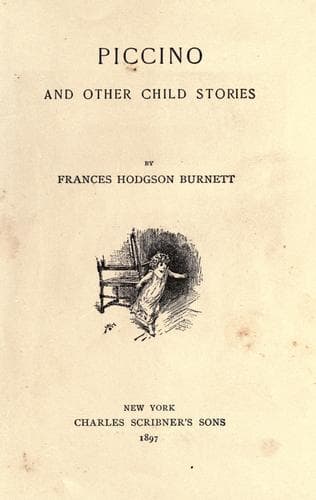
Piccino, and other child storiesBurnett, Frances Hodgson
General
Piccino, and other child stories
Burnett, Frances Hodgson
Children -- Conduct of life -- Juvenile fiction; Children's stories, American
There was an expression of countenance it was his habit to wear at
such times which was really a matter of the finest art. It combined
philosophic patience, genial leniency, and a sweet determination to
make the very best of a thing, which was really beautiful to behold.
It was at these times that a series of nursery romances, known as “The
Hair-Curling Series,” was invented and related. They were notable
chiefly for good, strong, dramatic coloring, and their point was the
illustration of the useful moral that little boys with a great deal of
beautiful curly hair are naturally rewarded—if they are always good
when it is brushed—by delightful adventures, such as being played with
by fairies and made friends with by interesting wild animals, whose
ravenous propensities are softened to the most affectionate mildness
by the sight of such high-mindedness in tender youth. There was one
story, known as “The Good Wolf,” which lasted for months, and was a
never-ending source of delight, as it rejoiced in features which could
be varied to adapt themselves to any circumstance or change of taste in
playthings. It was the laudable habit of the good wolf to give presents
to little boys who were deserving, besides taking them delightful rides
in a little sleigh, and one could vary the gifts and excursions to an
unlimited extent. Another, known as “The Mournful Story of Benny,” was
a fearful warning, but ended happily, and as it was not of a personal
nature was not disapproved of, and was listened to with respectful and
sympathizing interest, though “The Good Wolf” was preferred.
A delightfully intelligent little expression and an occasional dear
little gurgling laugh when the best points were made, convinced me that
the point of view of the listener was an appreciation of the humor
between the lines quite as clear, in a four-year-old way, as that of
the relater of the incidents. He revelled in the good wolf and was
concerned by the misfortunes of Benny, who had brought tragedy upon
himself by being so lost to all sense of virtue as to cut off his
curls, but he knew they were highly colored figures, and part of a
subtile and delightful joke.
But long before this he had learned to talk, and it was then that we
were introduced to the treasures of his mind.
What was the queer little charm which made every one like him so much,
which made every one smile when he looked at them, which made every one
listen when he spoke, which made arms quite involuntarily close around
his small body when he came within reach?
The person who made the closest study of his character devoted five or
six years to it before she was quite sure what this charm consisted
in. Then she decided that it was formed of a combination of fortunate
characteristics which might have lost all their value of fascination
but for their being illumined by the warmth and brightness of a purely
kind little heart, full of friendliness to the whole world.
Public-domain text, read in full here on John Shaqi.
Reviews
Reviews
No reviews yet
Be the first to share your thoughts on this work.
Elsewhere in the archive
Join the Discussion
Join the discussion
Sign in to leave a comment or review.
Sign InorCreate an account