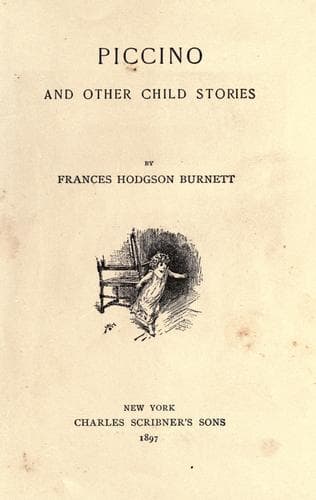
Piccino, and other child storiesBurnett, Frances Hodgson
General
Piccino, and other child stories
Burnett, Frances Hodgson
Children -- Conduct of life -- Juvenile fiction; Children's stories, American
He was pretty, but many little boys were pretty; he was quaint and
amusing, but so are many scores. The difference between this one tiny
individuality and others was that he seemed to have been born without
sense of the existence of any barrier between his own innocent heart
and any other.
I think it had never occurred to him that any one could possibly
be unfriendly or unloving to him. He was a perfectly human little
thing, not a young cherub, but a rational baby, who made his frocks
exceedingly dirty, and rejoiced sweetly in the making of mud pies. But,
somehow, his radiant smile of belief in one’s sympathy, even with his
mud pies, minimized the trouble of contending with the earthly features
of him.
His opinion evidently was that the world was made of people who
loved him and smiled if they saw him, of things one could play with
and stories one could listen to, and of friends and relations who
were always ready to join in the play and tell the stories. He went
peacefully to the curl-brushing ordeal, perhaps because of this
confiding sureness that any hand that dealt with him would touch him
tenderly. He never doubted it.
One morning, before he was three years old, he trotted into the
dining-room with a beautifully preoccupied expression, evidently on
business thoughts intent. The breakfast was over, but his mamma was
still sitting at the table, reading.
She heard the tiny pattering of feet coming down the hall before he
entered. She had thought him with his nurse, but he appeared to be
returning from some unusual expedition to the front door, which, as it
was a warm, early summer morning, stood open.
She was always curious about his mental processes, and so, when he
trotted to the table with his absorbed air, and stood upon his tiptoes,
making serious efforts to gain possession of a long loaf of French
bread, she regarded him with interest—he was so little, and the roll of
bread was so long, and his intentions to do something practical with it
were so evident. Somehow, one of his allurements was that he was always
funny, and he was so purely because his small point of view was always
so innocently serious.
“What does mamma’s baby want?” she asked. He looked at her with an
air of sweet good faith, and secured the bread, tucking it in all its
dignity of proportion under the very shortest possible arm.
“Lady,” he said, “lady, f’ont door—want b’ead,” and he trotted off,
with a simple security in the sense of doing the right and only
admissible thing, which it was reposeful to behold.
His mamma left her book hurriedly and trotted after him. Such a quaint
baby figure he was, with the long French roll under his arm! And he
headed straight for the front door.
Public-domain text, read in full here on John Shaqi.
Reviews
Reviews
No reviews yet
Be the first to share your thoughts on this work.
Elsewhere in the archive
Join the Discussion
Join the discussion
Sign in to leave a comment or review.
Sign InorCreate an account