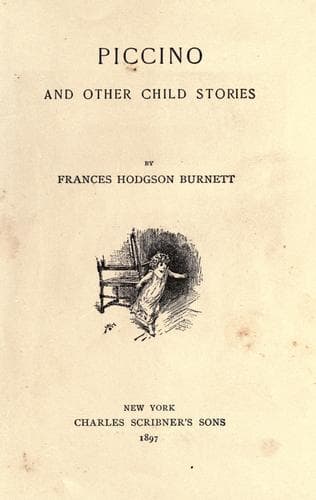
Piccino, and other child storiesBurnett, Frances Hodgson
General
Piccino, and other child stories
Burnett, Frances Hodgson
Children -- Conduct of life -- Juvenile fiction; Children's stories, American
It would be impossible to explain him without relating anecdotes. Is
there not an illustration of the politeness of his demeanor and the
grace of his infant manners in the reply renowned in his history,
made at the age of four, when his mamma was endeavoring to explain
some interesting point in connection with the structure of his small,
plump body? It was his habit to ask so many searching questions that
it was necessary for his immediate relatives to endeavor to render
their minds compact masses of valuable facts. But on this occasion
his inquiries had led him into such unknown depths as were beyond
him for the moment—only for the moment, of course. He listened to the
statement made, his usual engaging expression of delighted interest
gradually becoming tinged with polite doubtfulness. When the effort at
explanation was at an end he laid his hand upon his mamma’s knee with
apologetic but firm gentleness.
“Well, you see,” he said, “of course you know I _believe_ you, dearest”
(the most considerate stress was laid upon the “believe”), “but,
_ascuse_ me,” with infinite delicacy, “_ascuse_ me, I do _not_ think it
is true.”
The tender premonitory assurance that his confidence was unimpaired,
even though he was staggered by the statement made, was so
affectionately characteristic of him, and the apologetic grace of the
“ascuse me, dearest,” was all his own.
There might be little boys who were oblivious of, and indifferent
to, the attractions of simoons, who saw no charm in the interior
arrangements of camels, and were indifferent to the strata of the
earth, but in his enterprising mind such subjects wakened the liveliest
interest, and a little habit he had, of suddenly startling his family
by revealing to them the wealth of his store of knowledge, by making
casual remarks, was at once instructive and enlivening.
“A camel has ever so many stomachs,” he might sweetly announce, while
sitting in his high chair and devoting himself to his breakfast, the
statement appearing to evolve itself from dreamy reflection. “It fills
them with water. Then it goes across the desert and carries things.
Then it isn’t thirsty.”
He was extremely pleased with the camel, and was most exhaustive in his
explanations of him. It was not unlikely that Carrie and Dan might have
passed a strict examination on the subject of incidents connected with
the crossing of the Great Desert. He also found his bones interesting,
and was most searching in his inquiries as to the circulation of his
blood. But he had been charmed with his bones from his first extremely
early acquaintance with them, as witness an incident of his third year,
which is among the most cherished by his family of their recollections
of him.
He sat upon his mamma’s knee before the nursery fire, a small, round,
delightful thing, asking questions. He had opened up the subject of
his bones by discovering that his short, plump arm seemed built upon
something solid, which he felt at once necessary to investigate.
Public-domain text, read in full here on John Shaqi.
Reviews
Reviews
No reviews yet
Be the first to share your thoughts on this work.
Elsewhere in the archive
Join the Discussion
Join the discussion
Sign in to leave a comment or review.
Sign InorCreate an account