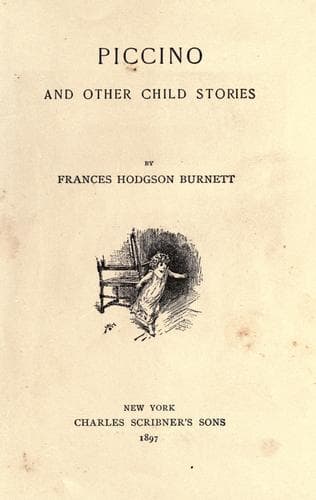
Piccino, and other child storiesBurnett, Frances Hodgson
General
Piccino, and other child stories
Burnett, Frances Hodgson
Children -- Conduct of life -- Juvenile fiction; Children's stories, American
There is a picture—not one of Mr. Birch’s—which I think will always
remain with me. It is ten years since I saw it, but I see it still.
It is the quaint one of a good-looking, stout, colored woman climbing
slowly up a back staircase with a sturdy little fellow on her back, his
legs astride her spacious waist, his arms clasped round her neck, his
lovely mop of yellow hair tumbling over her shoulder, upon which his
cheek affectionately and comfortably rests.
It does not come within the province of cooks to toil up-stairs with
little boys on their backs, especially when the little boys have stout
little legs of their own, and are old enough to wear Jersey suits and
warlike scarfs of red, but in this case the carrying up-stairs was an
agreeable ceremony, partly jocular and wholly affectionate, engaged
in by two confidants, and the bearer enjoyed it as much as did her
luxurious burden.
“We’re friends, you know,” he used to say. “Carrie’s my friend, and
Dan’s my friend. Carrie’s such a kind cook, and Dan’s such a nice
waiter.”
That was the whole situation in a nutshell. They were his friends, and
they formed together a mutual admiration society.
His conversation with them we knew was enriched by gems of valuable and
entertaining information. Among his charms was his desire to acquire
information, and the amiable readiness with which he imparted it to
his acquaintances. We gathered that while assisting in the making of
pudding he was lavish in the bestowal of useful knowledge. Intimate
association and converse with him had revealed to his mamma that
there was no historical, geographical, or scientific fact which might
not be impressed upon him in story form, and fill him with rapture.
Monsoons and typhoons, and the crossing of the Great Desert on camels,
he found absorbing; the adventures of Romulus and Remus, and their
good wolf, and the founding of Rome, held him spellbound. He found the
vestal virgins and their task of keeping up the sacred fires in the
temple sufficiently interesting to be made into a species of dramatic
entertainment during his third year. It was his habit to creep out of
his crib very early in the morning, and entertain himself agreeably in
the nursery until other people got up. One morning his mamma, lying in
her room, which opened into the nursery, heard a suspicious sound of
unlawful poking at the fire.
“Vivvie,” she said, “is that you?”
The poking ceased, but there was no reply. Silence reigned for a few
moments, and then the sound was heard again.
“Vivian,” said his anxious parent, “you are not allowed to touch the
fire.”
Small, soft feet came pattering hurriedly into the room; round the
footboard of the bed a ruffled head and seriously expostulatory little
countenance appeared.
“Don’t you know,” he said, with an air of lenient remonstrance, “don’t
you _know_ I’s a westal wirgin?”
Public-domain text, read in full here on John Shaqi.
Reviews
Reviews
No reviews yet
Be the first to share your thoughts on this work.
Elsewhere in the archive
Join the Discussion
Join the discussion
Sign in to leave a comment or review.
Sign InorCreate an account