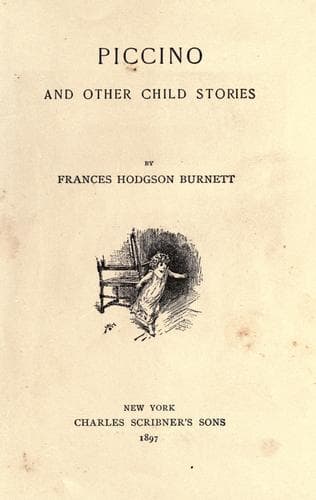
Piccino, and other child storiesBurnett, Frances Hodgson
General
Piccino, and other child stories
Burnett, Frances Hodgson
Children -- Conduct of life -- Juvenile fiction; Children's stories, American
Could one ever forget him as he appeared one day at the seaside, when
coming up from the beach with his brief trousers rolled up to his
stalwart little thighs? He stood upon the piazza, spade and bucket in
hand, looking with deep, sympathetic interest at a male visitor who
was on the point of leaving the house. This visitor was a man who had
recently lost his wife suddenly. He was a near relative of a guest in
the house, and the young friend of all the world had possibly heard
his bereavement discussed. But at six years old it is not the custom
of small boys to concern themselves about such events. It seems that
this one did, however, though the caller was not one of his intimates.
He stood apart for a few moments, looking at him with a tenderly
reflective countenance. His mamma, seeing his absorption, privately
wondered what he was thinking of. But presently he transferred both
spade and bucket to one hand, and came forward, holding out the other.
I do not think anything could have been quainter and more sweet than
the kind little face which uplifted itself to the parting guest.
“Mr. Wenham,” he said, “I’m _very_ sorry for you, Mr. Wenham, about
your wife being dead. I’m very sorry for you. I know how you must miss
her.”
Even the sympathy of six years old does not go for nothing. There was a
slight moisture in Mr. Wenham’s eyes as he shook the small, sandy hand,
and his voice was not quite steady as he answered, “Thank you, Vivvie,
thank you.”
It was when he was spending the summer at this place that he made the
acquaintance of the young lady whose pony he regarded as a model of
equine strength and beauty. It was the tiniest possible pony, whose
duty it was to draw a small phaeton containing a small girl and her
governess. But I was told it was a fine sight to behold the blooming
little gentleman caller standing before this stately equipage, his
hands on his hips, his head upon one side, regarding the steed with
quite the experienced air of an aged jockey.
“That’s a fine horse,” he said. “You see, it’s got plenty of muscle.
What I like is a horse with plenty of muscle.”
[Illustration: “I’M VERY SORRY FOR YOU, MR. WENHAM, ABOUT YOUR WIFE
BEING DEAD”]
And when we drove away from the cottage at the end of the summer, I
myself perhaps a shade saddened, as one often is by the thought that
the days of sunshine and roses are over, he put his small hand in mine
and looked up at me wistfully.
“We liked that little house, didn’t we, dearest?” he said. “We will
always like it, won’t we?”
“Do you know my friend Mrs. Wilkins?” he inquired one day, when he was
still small enough to wear white frocks, and not old enough to extend
his explorations further than the part of the quiet street opposite the
house he lived in.
“And who is your friend Mrs. Wilkins?” his mamma inquired.
Public-domain text, read in full here on John Shaqi.
Reviews
Reviews
No reviews yet
Be the first to share your thoughts on this work.
Elsewhere in the archive
Join the Discussion
Join the discussion
Sign in to leave a comment or review.
Sign InorCreate an account