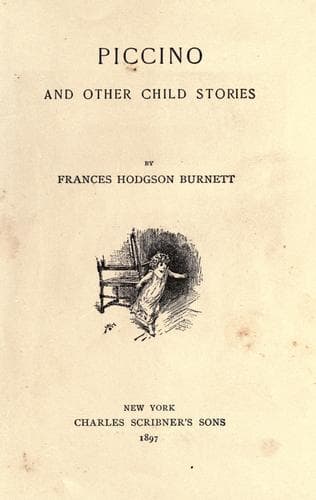
Piccino, and other child storiesBurnett, Frances Hodgson
General
Piccino, and other child stories
Burnett, Frances Hodgson
Children -- Conduct of life -- Juvenile fiction; Children's stories, American
“She is a very nice lady that saw me through her window when I was
playing on the pavement, and we talked to each other, and she asked
me to come into her house. She’s such a kind lady, and she paints
beautiful cups and saucers. She’s my friend. And her cook is a nice
lady too. She lives in the basemen’ and she talks to me through the
window. She likes little boys. I have two friends in that house.”
“My friend Mrs. Wilkins” became one of his cherished intimates. His
visits to her were frequent and prolonged.
“I’ve just been to see my friend Mrs. Wilkins,” he would say; or, “My
friend Mrs. Wilkins’s husband is very kind to me. We go to his store,
and he gives me oranges.”
It is not improbable that he also painted china during his calls upon
his friend Mrs. Wilkins. It is certain that, if he did not otherwise
assist, his attitude was that of an enthusiastic admirer of the art.
That his conversation with the lady embraced many subjects, we have
evidence in an anecdote frequently related with great glee by those to
whom the incident was reported. I myself was not present during the
ingenuous summing up of the charm of social life, but I have always
mentally seen him taking his part in the scene in one of his celebrated
conversational attitudes, in which he usually sat holding his plump
knee in a manner which somehow seemed to express deep, speculative
thought.
“Are you in society, Mrs. Wilkins?” he inquired, ingenuously.
“What _is_ being in society, Vivvie?” Mrs. Wilkins replied, probably
with the intention of drawing forth his views.
“It’s—well—there are a great many carriages, you know, and a great many
ladies come to see you. And they say, ‘How _are_ you, Mrs. Burnett?
So glad to find you at home.’ Gabble, gabble, gabble, gabble. ‘_Good_
morning!’ And they go away. That’s it.”
I am not quite sure that I repeat the exact phrasing, but the idea is
intact, and the point which inspired the hearers with such keen joy was
that he had absolutely no intention of making an unfriendly criticism.
He was merely painting an impressionist’s picture. On his own part he
was fond of society. It delighted him to be allowed to come into the
drawing-room on the days when his mamma was “at home.” This function
impressed him as an agreeable festivity. As he listened to the “gabble,
gabble, gabble,” he beamed with friendly interest. He admired the
ladies, and regarded them as beautiful and amiable. It was his pleasure
to follow the departing ones into the hall and render them gallant
assistance with their wraps.
“I like ladies, dearest,” he would say. “They are so pretty.”
At what age he became strongly imbued with the stanchest Republican
principles, it would be difficult to say. He was an unflinching
Republican.
Public-domain text, read in full here on John Shaqi.
Reviews
Reviews
No reviews yet
Be the first to share your thoughts on this work.
Elsewhere in the archive
Join the Discussion
Join the discussion
Sign in to leave a comment or review.
Sign InorCreate an account