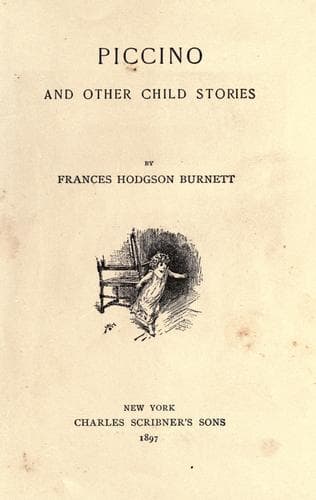
Piccino, and other child storiesBurnett, Frances Hodgson
General
Piccino, and other child stories
Burnett, Frances Hodgson
Children -- Conduct of life -- Juvenile fiction; Children's stories, American
The very first bud which appeared on the oldfashioned rose-bushes at
the back of the house was watched for and discovered when it was a
tiny, hard, green thing.
“There’s a bud,” he would say, “and I’m watching till it is a rose, so
that I can give it to you.”
There is nothing so loving as a child who is loved. What valuable
assistance he rendered in the matter of toilet! How charmed he was with
any pretty new thing! How delighted to be allowed to put on slippers
or take them off, to stand by the dressing-table and hand pins, and
give the benefit of his admiring advice. And how adorable it was to
come home late from a party and find the pincushion adorned with a
love-letter, scrawled boldly in lead pencil and secured by a long pin.
In conjunction with his brother—who was the troubadour of love from his
infancy, and who has a story of his own—he invented the most delightful
surprises for those late returns. Sometimes pieces of candy wrapped in
paper awaited the arrival, sometimes _billets doux_, sometimes singular
rhymes courageously entitled “A Valentine.” The following was the fine
flower of all:
“MY MAMA
“O my swetest little mama,
Sweteness that can ne’er be told
Dwells all decked in glory behind thy bosom folds.
In love and tender sweteness
Thy heart has no compare
And as through the path of sorrow
Thy heart goes wangering on
Thow always lend a helping hand
To all who are alone.
“ESEX ESSEX.”
“What does ‘Essex’ mean, darling?” I asked.
“I don’t know what it means,” he said, sweetly, “and I didn’t spell it
right at first. But, you know, when any one writes poetry they nearly
always put another name at the end, and I thought Essex would do.” He
was so desirous of making it complete!
CHAPTER III
IN BOYHOOD AND NOW
As a travelling companion what a success he was! How he made friends in
the train, at railway stations, on steamers! How, if one lost sight of
him for a moment, he invariably reappeared full of delight, with the
information that he had “found a friend.”
As I was struggling in the usual manner up the crowded gangway of an
ocean steamer on one occasion, his flushed and radiant countenance
appeared over the rail, where he had climbed.
“Dearest, dearest,” he said, “I’ve found a friend. He’s a French
gentleman and can’t speak English.” He had found him on the tug, and
they had apparently sworn eternal amity between the wharf and the
steamer, though how this had been accomplished I was never quite able
to determine, as he had only just begun to attack valiantly a verb
or so of the first conjugation. But with the assistance of “donner,”
“aller,” “aimer,” and a smile like his, nothing was impossible.
Public-domain text, read in full here on John Shaqi.
Reviews
Reviews
No reviews yet
Be the first to share your thoughts on this work.
Elsewhere in the archive
Join the Discussion
Join the discussion
Sign in to leave a comment or review.
Sign InorCreate an account