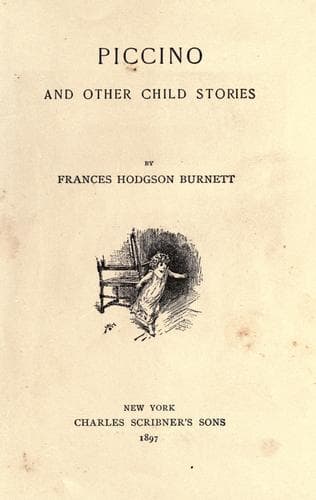
Piccino, and other child storiesBurnett, Frances Hodgson
General
Piccino, and other child stories
Burnett, Frances Hodgson
Children -- Conduct of life -- Juvenile fiction; Children's stories, American
What a picture of a beautiful, brave little spirit, aflame with young
fervor, he was the day I went into a room and found him reading for the
first time in his brief life the story of the American Revolution!
He sat in a large chair, one short leg tucked under him, a big book on
his knee, his love-locks tumbling over his ecstasied child face. He
looked up, glowing, when I entered. His cheeks were red, his eyes were
beautiful.
“Dearest,” he said, “dearest, listen. _Here’s_ a brave man, here’s a
brave man! This is what he says, ‘Give me liberty or give me death!’”
It was somehow so movingly incongruous—this “pretty page with dimpled
chin” stirred so valiantly by his “liberty or death.” I kissed his
golden thatch, laughing and patting it, but a little lump was in my
throat.
Where did he learn—faithful and tender heart—to be such a lover as he
was? Surely no woman ever had such a lover before! What taught him
to pay such adorable childish court, and to bring the first-fruits
of every delight to lay upon one shrine? In the small garden where
he played—a toddling thing, accumulating stains of grass and earth
in truly human fashion on his brief white frock—the spring scattered
sparsely a few blue violets. How he applied himself to searching for
them, to gather them with pretty laboriousness until he had collected
a small, warm handful, somewhat dilapidated before it was large enough
to be brought up-stairs in the form of a princely floral gift!
It is nearly fourteen years since they were first laid at my feet—these
darling little grubby handfuls of exhausted violets—but I can hear
yet the sound of the small feet climbing the staircase, stoutly but
carefully, the exultant voice shouting at intervals all the way up from
the first flight: “Sweet dearest! Sweet de-ar-est! I got somefin’ for
you! Please le’ me in.”
So many beautiful names had been tried by turns by himself and brother,
but they found “sweetest” and “sweet dearest” the most satisfactory.
Finally they decided upon “dearest” as combining and implying the
sentiment they were inspired by.
There was in a certain sacred workroom at the top of the house a
receptacle known as the “treasure drawer.” It was always full of
wonderful things, rich gifts brought carefully and with lavish
generosity from the grass in the back yard, from dust heaps, from the
street, from anywhere; bits of glass or pebble, gorgeous advertising
cards, queerly shaped twigs or bits of wood, pictures out of papers,
small, queer toys, possessing some charm which might make them valuable
to an appreciative maternal relative. And just before they were
presented I always heard the small feet on the stairs, the knock on the
door, and the delightful, confiding voice outside: “Please, may I come
in? I’ve brought a treasure for you, dearest.”
We always spoke of them as “treasures.” They seemed so beautiful and
valuable to the donor, that love brought them at once as a gift to
love, and the recipient saw them with his eyes.
Public-domain text, read in full here on John Shaqi.
Reviews
Reviews
No reviews yet
Be the first to share your thoughts on this work.
Elsewhere in the archive
Join the Discussion
Join the discussion
Sign in to leave a comment or review.
Sign InorCreate an account