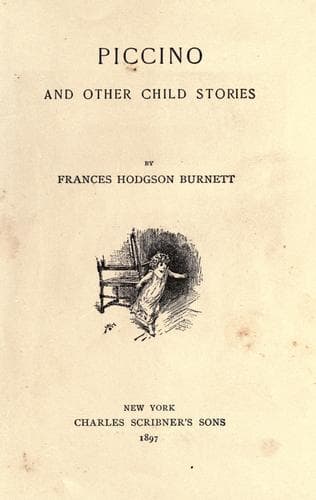
Piccino, and other child storiesBurnett, Frances Hodgson
General
Piccino, and other child stories
Burnett, Frances Hodgson
Children -- Conduct of life -- Juvenile fiction; Children's stories, American
Exactly what happened I could only guess at. I had reason to suppose
that my young protector and medical attendant was wakened with some
extra sense of flurry taking place. He evidently sat up in bed in
reproachful despair.
“What have I done?” said his brother. “What is the matter?”
I heard tears in the plaintive little voice that answered—actual tears.
“Oh!” he said, “I know you’ve wakened her! I know you have! It was so
hard to get her to sleep. And at last I did, and then I was so afraid
of wakening her that I went down on the floor and crawled out of the
room on my hands and knees. And I think it took an hour.”
“Darling,” I murmured, in the drowsiest possible tone, when he crept
into the room to look at me, “I’ve had a lovely sleep, and I’m going
to sleep again. You made me so quiet.” But with the most serious
difficulty I restrained myself from clutching him in my arms with a
force which would have betrayed to him all my adoring duplicity.
It was things such as these I remembered when he was so deliciously
amusing, and I heard stories of him every day.
Sometimes, when swinging in my hammock on the piazza, I caught sight
of him flying on his small bicycle down the tree-shaded avenue,
a delightful, animated picture, his strong, graceful child body
beautifully defined in his trim, closefitting Jersey suit, his red
scarf and fez brilliant touches of color, his waving, flying hair
brightened to gold as he darted through the sunshine and into the
shade. I used to say to myself: “He is so good to look at! He is so
pretty! That is why every one likes him so.” And then, when I heard him
say some quaint thing which was an actual delight through its droll
ingenuousness, I said: “It is because he is so amusing!”
So I studied him day after day, often trying to imagine the effect
his fearless candor and unsophisticated point of view would have upon
certain persons who did not know his type.
I was convalescing from my long illness, and had plenty of time to
amuse myself with such speculations. He was such a patriotic young
American; he was so engaged in an impending presidential election
at the time; his remarks were so well worth hearing. I began, among
other fancies about him, to imagine his making them with that frankly
glowing face to conservative English people. He had English blood in
his veins, and things more unheard-of had occurred than that, through a
combination of circumstances, he might be surrounded by things very new
to him.
“When a person is a duke,” he had said to me once, “what makes him
one? What has he done?” His opinion evidently was that dukedoms were a
species of reward for superhuman sweetness of character and brilliant
intellectual capacity. I began to imagine the interest that would be
awakened in his mind by the contemplation of ducal personages.
Public-domain text, read in full here on John Shaqi.
Reviews
Reviews
No reviews yet
Be the first to share your thoughts on this work.
Elsewhere in the archive
Join the Discussion
Join the discussion
Sign in to leave a comment or review.
Sign InorCreate an account