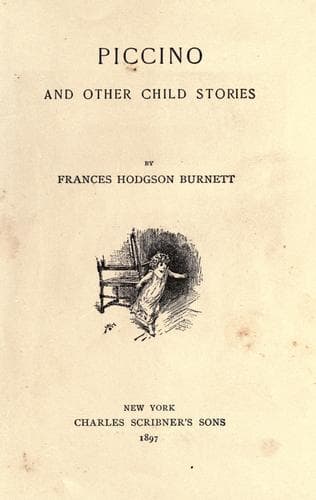
Piccino, and other child storiesBurnett, Frances Hodgson
General
Piccino, and other child stories
Burnett, Frances Hodgson
Children -- Conduct of life -- Juvenile fiction; Children's stories, American
It amused me to analyze the subject of what his point of view would be
likely to be. I knew it would be productive of immense entertainment to
his acquaintances. I was sure that the duke would be subjected to sweet
but searching cross-questioning, and that much lively interest would
be felt in the subject of coronets. He would regard them as a species
of eccentric hat. What questions he would ask, what enthusiasm he would
display, when he was impressed by things beautiful or stately and
interesting! Would he seem “a cheeky little beggar” to less republican
minds than his own? I asked myself this curiously. But no, I was sure
he would not. He would be so simple; he would expect such splendor of
mind and of noble friendliness that the hypothetical duke would like
him as Dan and Carrie did, and he would end by saying “My friend the
Duke of Blankshire,” as affectionately as he had said “My friend the
milkman.”
It was only a thread of fancy for a while, but one day I had an idea.
“I will write a story about him,” I said. “I will put him in a
world quite new to him, and see what he will do. How shall I bring
a small American boy into close relationship with an English
nobleman—irascible, conservative, disagreeable? He must live with him,
talk to him, show him his small, unconscious, republican mind. He will
be more effective if I make him a child who has lived in the simplest
possible way. Eureka! Son of younger son, separated from ill-tempered
noble father because he has married a poor young American beauty.
Young father dead, elder brothers dead, boy comes into title! How it
would amaze him and bewilder him! Yes, there it is, and Vivian shall
be he—just Vivian, with his curls and his eyes, and his friendly, kind
little soul. Little Lord Something-or-other. What a pretty title—Little
Lord ——, Little Lord —— what?”
[Illustration: THE REAL FAUNTLEROY LISTENING TO THE STORY OF THE IDEAL
FAUNTLEROY]
And a day later it was Little Lord Fauntleroy. A story like that is
easily written. In part, it was being lived before my eyes.
“I can wash myself quite well, thank you,” he said, scrubbing
vigorously one day. “I can do it quite well, dearest, if some one will
just ’zamine the corners.”
He had always spoken very clearly, but there were a few words his
pronunciation of which endeared them inexpressibly to me. On the
evening of the day before “Fauntleroy” spent his first morning with
“Lord Dorincourt” he brought into my room a parlor base-ball game to
show me.
It was a lovely thing to see his delight over it, and to note the care
with which he tried to make all technical points clear to an interested
but unintelligent parent. What vigorous little attitudes he threw
himself into when he endeavored to show me how the ball was thrown in
the real game!
“I’m afraid that I am a very stupid little mammy,” I said. “What does
the first base do? And what is the pitcher for? I’m very dull, you
see.”
Public-domain text, read in full here on John Shaqi.
Reviews
Reviews
No reviews yet
Be the first to share your thoughts on this work.
Elsewhere in the archive
Join the Discussion
Join the discussion
Sign in to leave a comment or review.
Sign InorCreate an account