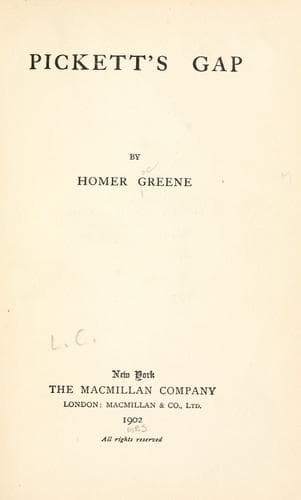
Country life -- Juvenile fiction; Fathers and sons -- Juvenile fiction; Grandfathers -- Juvenile fiction
At the time of the events here recorded, two rival railroad corporations
had become suddenly aware of the value of Pickett’s Gap as an outlet
from the anthracite coal fields easterly to the Delaware river and to
tidewater. Not that the project of building a railroad across that
section of country was by any means a new one. On the contrary, it had
been talked of for years. Indeed, a survey had once been made to within
a mile of the mouth of the gap, but the stakes had rotted away or been
destroyed long before. It was due to a combination of certain great
railroad and coal interests that the subject had been now revived. And
the engineers, looking over the ground, became suddenly impressed with
the importance of securing the Pickett’s Gap route. From that moment it
was a race between the Delaware Valley and Eastern Railroad Company and
the Tidewater and Western Railroad Company to secure the right of way
through Pickett’s Gap. This gorge, the only opening for fifteen miles
through the ridge that flanked the westerly shore of the Delaware,
became thenceforth the objective point toward which the engineers of
both railroad companies bent all their energies. The D. V. & E. worked
up toward it from the Delaware and the east; while the T. & W. came down
the country from the west, adopting, unknown to its rival, the old survey
of former years. From information received at the office of the T. & W.
it was known that Nicholson, the D. V. & E. engineer, was, on a certain
day in September, working up from the shore of the Delaware toward the
mouth of the gorge, and that, in all probability, he would set his stakes
in that coveted glen on the following day. There was only one way to
outwit him and gain precedence, and that was by connecting with the
terminal point of the old survey, and making a night location through the
gap. This scheme originated in the fertile mind of the chief engineer of
the T. & W., and he sent his most trusted lieutenant, Charlie Pickett, to
carry out the plan. No better selection could have been made, for Charlie
Pickett was familiar with every foot of the ground. By his own unaided
effort through thirteen years he had risen through the various positions
of axeman, chainman, flagman, rodman, and leveller, until now, as
transitman, he was intrusted with the most careful and critical work of
one of the youngest and most vigorous of the railroad corporations of
Pennsylvania.
Public-domain text, read in full here on John Shaqi.
Reviews
Reviews
No reviews yet
Be the first to share your thoughts on this work.
Join the Discussion
Join the discussion
Sign in to leave a comment or review.
Sign InorCreate an account