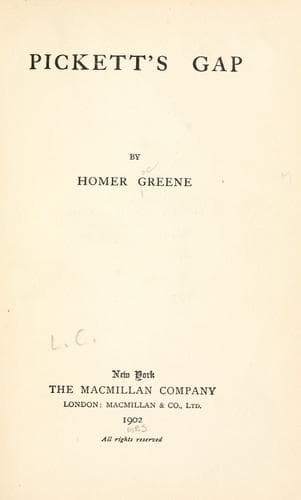
Country life -- Juvenile fiction; Fathers and sons -- Juvenile fiction; Grandfathers -- Juvenile fiction
It was plain to the dullest understanding that the boy was frank and
truthful, and that the old man was not inclined to shirk his share
of the responsibility. But Marshall was not yet satisfied. He wanted
not only the truth, but the whole truth. It was due to his client
that every fact should be brought out in detail. He took up again the
regular order of examination.
“Were you subpœnaed as a witness in this case?” he asked.
“No,” replied Dannie, “I wasn’t.”
“Then what was it that led you to come here and make this remarkable
statement?”
“Well, I’ll tell you how it was. I got to thinkin’ about it yesterday,
after they’d all gone, and I thought an’ thought, till it seemed as
if it’d kill me if I didn’t tell somebody. An’ so, last night, I told
Aunt Martha. An’ she said the only way to make it right was by tellin’
those that had been injured by what I’d done. So we made it up between
us that I was to come up here the first thing this mornin’ an’ tell it
all. And I tried to get here before court began; but--but I couldn’t
make out to do it. I--I’m sorry I was so long comin’; but I hope it
ain’t too late?”
Marshall looked up at him incredulously.
“You haven’t come here from Pickett’s Gap to-day, my boy?”
“Yes, sir. I left there this mornin’ real early; before it began to
drift much.”
“But the roads are absolutely impassable!”
“I know. We had hard work. The roads were drifted full. I came in the
stage as far as the poor-house. The horses gave out there. Then the
stage driver and I, we footed it as far as Keene’s. From there I walked
on to Mooreville alone.”
As he recalled that awful journey Dannie looked up wearily, and out
over the sea of sympathetic faces turned toward him in the court room.
But he was too tired to see them. They floated indistinctly before him.
They seemed to advance and recede, to expand and contract, alternately
to fade and find form before his aching eyes.
“And did you think it necessary to come here at the risk of your life
to make this acknowledgment?” asked Marshall.
“Why, I didn’t think just that way about it,” replied the boy; “but I
knew I’d done wrong to keep it to myself so, an’ I felt that I ought
to get here an’ tell about it as soon as I could. I wanted Gran’pap
to know. I never kept anything from him before, an’ I wanted to tell
him first, because he’s done more for me, an’ been kinder to me than
anybody else. An’ then--an’ then I’d heard that the engineer who made
the night survey had been accused o’ pullin’ out those stakes, or
havin’ ’em pulled out; an’ I was afraid they’d try to prove it on ’im
here, an’ maybe find ’im guilty of it before I could get here an’ set
’em right. And I wouldn’t ’a’ had that happen--why, I’d sooner ’a’ died
in the snow than had ’em do that. He was so good to run his line around
the graveyard. He was so gentle, an’ kind, an’--an’, oh, he couldn’t
’a’ been kinder an’ gentler an’ sweeter to me if he’d ’a’ been my own
father.”
Public-domain text, read in full here on John Shaqi.
Reviews
Reviews
No reviews yet
Be the first to share your thoughts on this work.
Join the Discussion
Join the discussion
Sign in to leave a comment or review.
Sign InorCreate an account