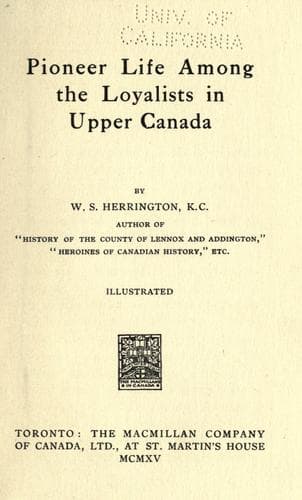
Pioneer Life among the Loyalists in Upper CanadaHerrington, Walter Stevens
History
Pioneer Life among the Loyalists in Upper Canada
Herrington, Walter Stevens
Frontier and pioneer life -- Ontario
washed and carded the wool.
Every maiden served her apprenticeship at the spinning wheel, and her
education was not complete until she had learned how to spin the yarn,
pass it over the swift, and prepare it for the loom, which had become a
part of the equipment of nearly every house. The linen, flannel, and
fullcloth for the entire family were made upon the premises. Service
was more sought after than style, particularly in the "everyday
clothes"; and, if the mother or maiden aunt could not cut and make a
suit, the first itinerant tailor who happened along was installed as a
member of the household for a fortnight and fitted out the whole family
for the next year.
The boots and shoes were also homemade, or at least made at home.
Somewhere about every farm was to be found a tanning-trough, in which a
cowhide would be immersed for three weeks in a weak solution of lye to
remove the hair and any particles of flesh still adhering to the skin.
It was then transferred to a tub containing a solution of oak bark and
left for several months, after which it was softened by kneading and
rubbing, and was then ready to be made up. The making of the boots
required considerable skill. A man can wear and obtain good service
from an ill-made suit of clothes, but a poor-fitting pair of boots is an
abomination likely to get the wearer into all sorts of trouble. Corns
and bunions are not of modern origin, but have afflicted the human race
ever since boots were first worn. A kit of shoemaker’s tools, composed
of a last, hammer, awls, and needles, was to be found in every house;
and some member of the family was usually expert in adding a half-sole
or applying a patch; few, however, attempted to make the boots. The
travelling shoemaker went about from house to house and performed this
service. A few years later every neighbourhood had its tannery, and
every village its one or more shoemakers. The tanner took his toll for
each hide; and the shoemaker, for a bag of potatoes, a roll of butter,
or a side of pork, would turn out a pair of boots, which would long
outwear the factory-made article of to-day.
The skins of the bear, fox, and racoon furnished fur caps for the
winter; and the rye straw supplied the material for straw hats for
summer. In nearly every house some one would be found capable of
producing the finished articles from these raw materials. The milliner,
as such, would have had a hard time in earning a living a hundred years
ago, as head-gear at that time was worn to protect the head.
Public-domain text, read in full here on John Shaqi.
Reviews
Reviews
No reviews yet
Be the first to share your thoughts on this work.
Join the Discussion
Join the discussion
Sign in to leave a comment or review.
Sign InorCreate an account