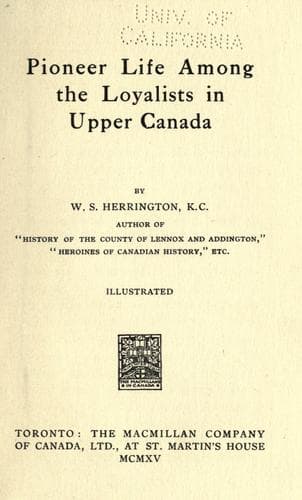
Pioneer Life among the Loyalists in Upper CanadaHerrington, Walter Stevens
History
Pioneer Life among the Loyalists in Upper Canada
Herrington, Walter Stevens
Frontier and pioneer life -- Ontario
By another Act of 1792 the German names of the four districts were
changed respectively to the more acceptable English ones. Eastern,
Midland, Home, and Western; and provision was made for the erection of a
gaol and court-house in each of them. Before these very necessary public
buildings were erected, even the higher courts were held in cramped and
uncomfortable quarters. It is said that the first sentence of capital
punishment imposed in Upper Canada was pronounced in a tavern on the
shore of the Bay of Quinte at Bath, and, as summary execution was the
recognized method of carrying into effect the judgment of the court, the
convict was immediately hanged to a basswood tree on the roadside, only
a few rods distant. The pathetic part of this tragic incident is that
it was afterwards learned that the poor victim was innocent of the
charge of which he was found guilty, the theft of a watch. Such a
stigma attached to this particular basswood tree that it was adopted and
used for years as a public whipping-post.[#]
[#] This incident was, I believe, first published by Dr. Canniff in 1869
in his _Settlement of Upper Canada_. I am unable to point to any
official record bearing out his statement; but up to a few years ago old
residents, including descendants of the tavern-keeper, told the story
and evidently believed it.
In the early courts the parties before them were occasionally
represented by counsel; but the only recognized standard of admission to
the bar was under an ordinance of the old Province of Quebec, and few
were called. Under such conditions it can readily be conceived that it
would be difficult to maintain any uniformity in the practice. In 1794
the Legislature empowered the governor, lieutenant-governor, or person
administering the affairs of the province, to "authorize by license,
under his hand and seal, such and so many of His Majesty’s liege
subjects, not exceeding sixteen in number, as he shall deem from their
probity, education, and condition in life best qualified, to act as
advocates and attorneys in the conduct of all legal proceedings in the
province." In 1803 the demand for lawyers had become so pressing—at
least so it was alleged—that an Act was passed making it lawful to add
in a similar manner six more practitioners to the roll. Neither of
these Acts called for any educational test or professional experience.
It is not therefore a matter of surprise to learn that the gentlemen of
the long robe, who were thus admitted to the bar, were sometimes alluded
to as "heaven-born lawyers", though some of them were of the highest
standing, one becoming a judge of the King’s Bench, another treasurer of
the Law Society.
Public-domain text, read in full here on John Shaqi.
Reviews
Reviews
No reviews yet
Be the first to share your thoughts on this work.
Join the Discussion
Join the discussion
Sign in to leave a comment or review.
Sign InorCreate an account