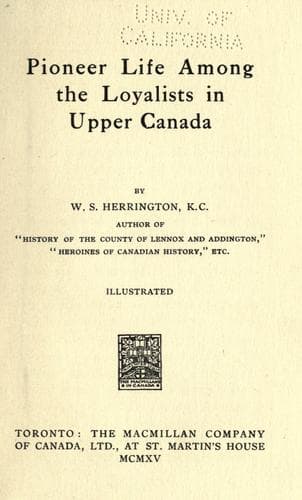
Pioneer Life among the Loyalists in Upper Canada — John Shaqi
Pioneer Life among the Loyalists in Upper CanadaHerrington, Walter Stevens
History
Pioneer Life among the Loyalists in Upper Canada
Herrington, Walter Stevens
Frontier and pioneer life -- Ontario
[#] The first enactment of any kind respecting schools in Upper Canada
was passed in 1807. This made very inadequate provision for the
establishment of one public school in each district. The first
legislative attempt to encourage, assist, or regulate common schools was
by an Act passed in 1816. Both of these statutes were very crude and
left much to be desired.
The first efforts were those of the mother and other elder members of
the household. Later on a few families clubbed together and employed a
man to instruct their children in the rudimentary elements of a common
school education. There was no building for the purpose, so a room was
set apart in one of the dwellings, probably the only room on the ground
floor, and while the good housewife busied herself about her duties on
one side of the room the teacher was training the young ideas how to
shoot on the other side. For one or two weeks he would remain with this
family, getting his board and washing and two or three dollars a week,
and then he would move on to the next neighbour with his little flock,
and so on until the circuit of his subscribers of five or six families
was completed, when he commenced again at the first.
As late as 1818 in a contract entered into between a teacher and a few
of the farmers in one of the first townships, we find the covenant to
teach in the following words: "That the party of the first part engages
to keep a good school according to his ability, and to teach reading,
writing, and arithmetic." His hours were from eight o’clock in the
morning until four in the afternoon, with one and one-half hours for
noon. He was to teach every alternate Saturday. In addition to his
board, lodging, and washing, he was to be paid the princely salary of
twelve and one-half dollars a month, "whereof one-half in cash at the
end of the quarter and the other in orders or other value monthly."
Soon the little log school-house appeared, not larger than fifteen by
twenty feet, with a door in one end and a window on each side. On the
inside holes were bored in the logs about two feet six inches from the
floor, pegs inserted, and upon these pegs rested a plank. This was the
desk, and the pupils, while working at it, necessarily sat with their
faces towards the wall. A rude bench without a back was the only seat.
Books were very scarce. About the only real school book that ever found
its way into the hands of the pupil was Mayor’s spelling book. The New
Testament was the universal reader, and if any other books were in use
in the school the teacher was the only one who had access to them. The
three R’s: "Reading, Riting, and Rithmetic" were the extent of the
general curriculum. There were no authorized text-books, and such as
were in use were far from perfect.[#]
Public-domain text, read in full here on John Shaqi.
Reviews
Reviews
No reviews yet
Be the first to share your thoughts on this work.
Join the Discussion
Join the discussion
Sign in to leave a comment or review.
Sign InorCreate an account