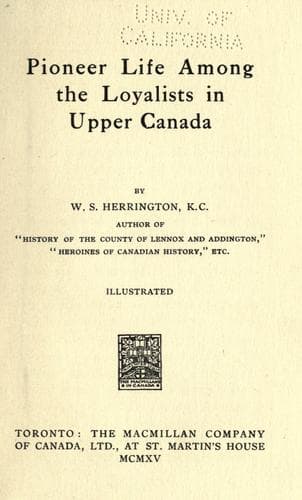
Pioneer Life among the Loyalists in Upper Canada — John Shaqi
Pioneer Life among the Loyalists in Upper CanadaHerrington, Walter Stevens
History
Pioneer Life among the Loyalists in Upper Canada
Herrington, Walter Stevens
Frontier and pioneer life -- Ontario
The Loyalists were above the ordinary type of emigrants who, too
frequently, having made a failure of life in their native surroundings,
seek other fields in which to begin anew their struggle for existence.
When the thirteen British colonies declared their independence, there
were many thousands of their best citizens, men of means and influence,
who looked upon the British flag as their best safe-guard of freedom and
justice, and they declined to take up arms against their Motherland.
Their loyalty brought down upon their heads the wrath of the leaders of
the revolutionary movement. Their property was confiscated, some were
thrown into prison, and, in a few instances, the death penalty was
inflicted, for no other offence than their allegiance to the British
Crown. In the face of such threatened dangers thousands rallied to the
standard of the king, and many more, who for various reasons, did not
enlist in the army, made no secret of their loyalty to their sovereign.
When hostilities were concluded, the persecutions still continued, and
the Loyalists found themselves little better than outcasts from their
own homes. Giving up all hope of regaining their property or receiving
compensation for their losses, they set about to seek new homes under
the flag for which they had sacrificed so much. Thousands went to
England, many more thousands emigrated to the British West Indies, Nova
Scotia, and what is now New Brunswick, and large numbers were attracted
to the rich farm lands in that territory which was afterwards known as
Upper Canada.
In the autumn of 1783 a great body of emigrants sailed from New York,
and, coming around through the Gulf of St. Lawrence, wintered at Sorel,
in the present province of Quebec. In the following June they proceeded
by means of flat-bottomed boats, to the land provided for them. By far
the greater number settled in the new townships laid out, under
instructions from Governor Haldimand, on the St. Lawrence, and as far
west as the head of the Bay of Quinte. Only a few went farther west and
settled in the neighbourhood of Niagara and Detroit.
During the next four years straggling bands of one or more families came
by different routes to share the fortunes of the first great army of
settlers, and the strictest care was exercised by the authorities to see
that none but those who had demonstrated their loyalty to the British
cause were admitted to the new settlements.
The appellation "United Empire Loyalist" was not conferred
indiscriminately upon all applicants, but was a "Mark of Honour"
bestowed only upon those who had taken their stand for the unity of the
Empire, and who had allied themselves with the Royalists before the
Treaty of Separation in 1783. The terms of the proclamation creating
this new Canadian aristocracy were broad enough to embrace practically
all of the first settlers of 1784, and those who arrived during the
succeeding four years.
Public-domain text, read in full here on John Shaqi.
Reviews
Reviews
No reviews yet
Be the first to share your thoughts on this work.
Join the Discussion
Join the discussion
Sign in to leave a comment or review.
Sign InorCreate an account