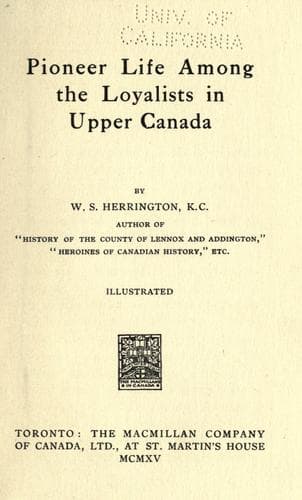
Pioneer Life among the Loyalists in Upper Canada — John Shaqi
Pioneer Life among the Loyalists in Upper CanadaHerrington, Walter Stevens
History
Pioneer Life among the Loyalists in Upper Canada
Herrington, Walter Stevens
Frontier and pioneer life -- Ontario
The mother or grandmother, as a rule, was the doctor, nurse, and
apothecary for the whole family. In the month of September, or perhaps
October, when the phase of the moon was supposed to be favourable for
the purpose, she organized an expedition to the woods in search of a
supply of herbs to replenish her medicine chest. In some cases she dug
in the ground for roots, in others the bark, leaves, or stems were
sought, and in others still the fruit or seeds possessed the necessary
medicinal properties. When she had gathered in her stores, she tied
them up in bundles and hung them up in the attic, or stowed them away in
some convenient nook until required. Her collection contained specifics
for nearly every ache and pain.
It may be that in those days there was not the mad rush for excitement
and wealth, and the average citizen kept better hours, ate more plain
and wholesome food, had some respect for the different organs of his
body, and did not make such ridiculous demands upon them as are made by
some of the high livers of to-day. It may be, too, that mother’s simple
remedies went a long way to correct the excesses and indulgences of the
weak and careless and to restore the health of the sickly. In any event
the mortality among the pioneers does not appear to have been any
greater than it is to-day. It may not be out of place to enumerate some
of the uses to which some of the common herbs were put, as they possess
the same, if any, medicinal properties to-day.
For coughs and colds, a syrup was made from the roots of the spignet,
another name for spike-nard. The tuber of the blood-root was dried and
then grated into a fine powder; this was snuffed up the nostrils as a
cure for polypus. Catnip has lost little of its popularity as a
medicine for children. There are few, if any, of us who have not
protested vehemently against having our mouths pried open to receive a
spoonful of tea made from the leaves of this common weed; the first
symptoms of a stomach-ache were sufficient to set the vile decoction
brewing and almost any affection of the throat called for a dose of the
same liquid.
The word "tansy" is derived indirectly from a Greek word meaning
"immortality", because the yellow blossoms, when dried, lose very little
of their original shape and colour. It is doubtful if the name had
anything to do with the prescribing of tansy-tea as a tonic. It was
extensively used for this purpose, and I can readily conceive a patient,
after taking a dose, being quite ready to eat the first thing in sight
to overcome the disagreeable taste left in his mouth by the medicine.
Hop-tea for indigestion and cherry bark tea for regulating the blood
were remedies widely known and extensively used.
Public-domain text, read in full here on John Shaqi.
Reviews
Reviews
No reviews yet
Be the first to share your thoughts on this work.
Join the Discussion
Join the discussion
Sign in to leave a comment or review.
Sign InorCreate an account