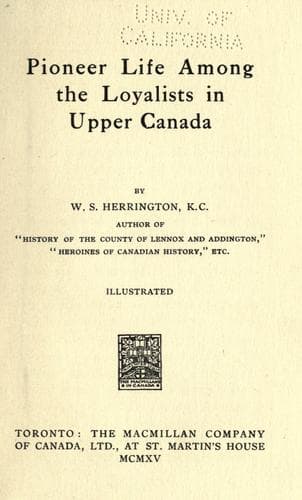
Pioneer Life among the Loyalists in Upper Canada — John Shaqi
Pioneer Life among the Loyalists in Upper CanadaHerrington, Walter Stevens
History
Pioneer Life among the Loyalists in Upper Canada
Herrington, Walter Stevens
Frontier and pioneer life -- Ontario
For the same reason that there was no door, there was precious little
furniture. Some of the Loyalists brought with them from their former
homes a few pieces—a grandfather’s chair, a chest of drawers, or a
favourite bedstead; but, as a rule, there was no furniture but such as
was hewed out with the axe and whittled into shape and ornamented with a
pocket-knife. A pocket-knife and a pen-knife were not the same. The
former was a strong knife made to serve many useful purposes, while the
latter was a small knife carried mainly for the purpose of shaping quill
pens.
For a bedstead, there was a platform of poles across one end of the
room, about two feet above the floor, supported by inserting the ends
between the logs in the wall. Bough benches with four legs served as
seats, and a table was similarly constructed on a larger scale. Later
on, when lumber was obtainable, these articles of furniture were
replaced by more serviceable ones. The deal table, the board bench, and
the old-fashioned chair with the elm bark bottom and back, woven as in a
basket, were one step in advance. It not infrequently happened that in
large families there were not enough seats to accommodate all, and the
younger members stood up at the table during meal-time or contented
themselves with a seat upon the floor. If a bedstead could be afforded
it was sure to be a four-poster with tester and side curtains. "What
was a tester?" do I hear someone enquire? It was a cloth canopy
supported by the four tall bed-posts. Bunks were built against the
walls, which served as seats in the daytime; but when opened out, served
as beds at night. Mattresses were made of boughs, corn husks, straw, or
feathers, and rested upon wooden slats, or more frequently cords laced
from side to side and end to end of the framework of the bedstead. A
trundle bed for the children was stowed away under the bedstead during
the daytime and hauled out at night. This was like a large bureau
drawer, with rollers or small wooden wheels on the bottom and handles in
front. The handles consisted of short pieces of rope, the ends of which
ran through two holes and were knotted on the inner side.
Public-domain text, read in full here on John Shaqi.
Reviews
Reviews
No reviews yet
Be the first to share your thoughts on this work.
Join the Discussion
Join the discussion
Sign in to leave a comment or review.
Sign InorCreate an account