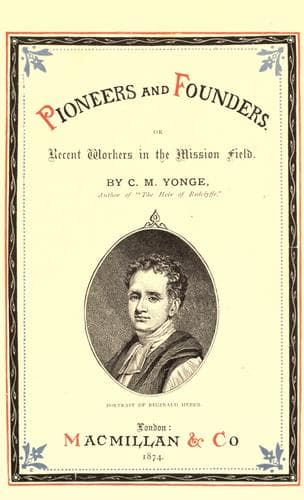
Pioneers and Founders: or, Recent Workers in the Mission fieldYonge, Charlotte M. (Charlotte Mary)
History
Pioneers and Founders: or, Recent Workers in the Mission field
Yonge, Charlotte M. (Charlotte Mary)
Missionaries
At Calcutta, Sir George Barlow sent to forbid Mr. Carey and his
colleagues from making any further attempts at conversion, and for a
short time they were entirely restricted to the Danish territory, while
Chater and Robinson were ordered to embark for England, and were only
kept by their appeal to the flag of Denmark.
Upon this Mr. Chater proceeded to Rangoon, an independent province, but
on the whole the current of opposition was diminishing. Lord Wellesley
and Mr. Pitt had prevailed upon Government not to permit the College at
Fort William to be broken up, though it was reduced and remodelled. Mr.
Carey was a gainer by the change, for he was promoted to a professorship,
with an increase of salary, which he said was "very good for the
mission." He soon after received the diploma of a Doctor of Divinity
from an American University.
The head-quarters of the establishment continued to be at Serampore,
where the missionaries and their families still lived in common,
supported upon the proceeds of Mr. Carey's professorship, Mr. Marshman's
school, and likewise the subscriptions received from England. Here were
their chapel, their schools, and their printing-press, from whence
emanated such books and tracts in Bengalee as could be useful for their
purpose, and likewise their great work, the translation of the
Scriptures, which Marshman and Carey were continually revising and
improving as their knowledge of the language became more critical. Thence
Mr. Carey went to give instruction at Fort William, and thence the
preachers, as the opposition relaxed, went forth on expeditions into the
country to teach, argue, and persuade, without any very wide-spread
success, but still every year gaining a few converts--sometimes as many
as twenty--who, when they had given sufficient evidence of faith, were
always publicly baptized by immersion, according to the custom of the
sect, which indeed acknowledged no other form as valid, and re-baptized
such members of other communions as joined them. Every missionary to the
East Indies, whether belonging to their own society or not, was certain
to visit and hold council with them, as the veterans of the Christian
army in India, and the men most experienced in the character and language
of the natives; they were the prime leaders and authorities in all that
concerned the various vernacular translations of the Scriptures, and
their example was as a trumpet-call to others to follow them in their
labours; while all the time the simplicity, humility, self-denial, and
activity of the men themselves remained unspoiled.
Public-domain text, read in full here on John Shaqi.
Reviews
Reviews
No reviews yet
Be the first to share your thoughts on this work.
Elsewhere in the archive
Join the Discussion
Join the discussion
Sign in to leave a comment or review.
Sign InorCreate an account