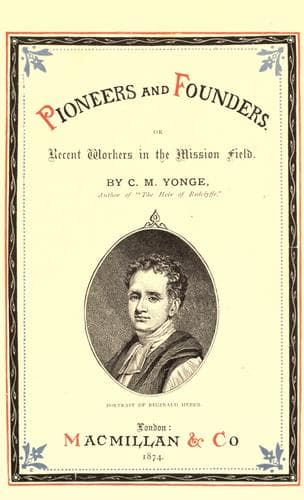
Pioneers and Founders: or, Recent Workers in the Mission fieldYonge, Charlotte M. (Charlotte Mary)
History
Pioneers and Founders: or, Recent Workers in the Mission field
Yonge, Charlotte M. (Charlotte Mary)
Missionaries
Another young man was at the very same time at Oxford, whose course had
been steered thither with more difficulties than Reginald Heber's. Daniel
Wilson's father was a wealthy silk manufacturer, at Spitalfields, where
he was born in the year 1778. He was educated at a private school at
Hackney, kept by a clergyman named Eyre, who must have had a good deal of
discernment of character, for he said, "There is no milk and water in
that boy. He will be either something very bad or very good." One day,
when he was in an obstinate and impracticable state of idleness, Mr. Eyre
said, "Daniel, you are not worth flogging, or I would flog you," which so
stung him that he never fell into similar disgrace again; nay, one
morning when he had failed in his appointed task, he refused food saying,
"No! If my head will not work, my body shall not eat." He had
considerable powers, and when his own theme on a given subject was
finished, would find "sense" for all the dull boys--varying the matter
but keeping to the point in all: but his education ceased at fourteen,
when he was bound apprentice to his uncle, who followed the same trade as
his father, and lived in Cheapside. He was a widower with seven
children, one of whom in after years became Daniel's wife. It was a
strictly religious household, and whereas Daniel's parents had been wont
to attend church or meeting as suited them best, his uncle was a regular
churchman, and took his whole family constantly with him, as decidedly as
he kept up discipline in his warehouse, where the young men had so little
liberty, that for weeks together they never had occasion to put on their
hats except on Sunday.
Daniel was a thoughtless, irreverent lad, full of schoolboy restlessness
when first he came; but though he was at first remarkable for his ill-
behaviour in church, his attendance insensibly took effect upon him, as
it brought his mind under the influence of the two chief powers for good
then in London, John Newton and Richard Cecil. The vehement struggle for
conversion and sense of individual salvation that their teaching deemed
the beginning of grace took place, and he turned for aid to them and to
his old schoolmaster, Mr. Eyre. It was from his hands in 1797, at the
age of nineteen, that he received his first Communion, with so much
emotion and such trembling, that he writes to his mother, "I have no
doubt I appeared very foolish to those about me," but he adds in another
letter to a friend that it had been the happiest day of his life. "And
to you I confess it," he says, "(though it ought perhaps to be a cause
for shame,) that I have felt great desire to go or do anything for the
love of JESUS, and that I have even wished, if it were the Lord's will,
to go as a missionary to foreign lands."
Public-domain text, read in full here on John Shaqi.
Reviews
Reviews
No reviews yet
Be the first to share your thoughts on this work.
Elsewhere in the archive
Join the Discussion
Join the discussion
Sign in to leave a comment or review.
Sign InorCreate an account