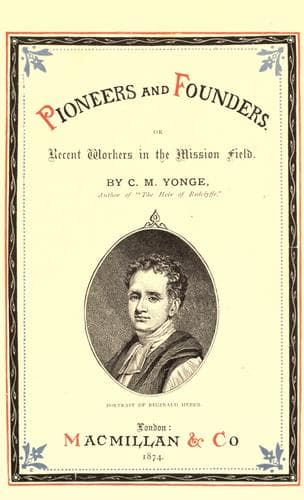
Pioneers and Founders: or, Recent Workers in the Mission fieldYonge, Charlotte M. (Charlotte Mary)
History
Pioneers and Founders: or, Recent Workers in the Mission field
Yonge, Charlotte M. (Charlotte Mary)
Missionaries
It is very remarkable that this thought should have occurred at such a
moment to one who only became a missionary thirty-five years later, at a
summons from without, not from within. The distinct mission impulse
passed away, but a strong desire remained to devote himself to the
ministry of the Church. He tried to stifle it at first, lest it should
be a form of conceit or pride; but it only grew upon him, and at last he
spoke to Mr. Eyre, who promised to broach the subject to his parents.
His father was strongly averse to it, as an overthrow to all his plans,
and Mr. Eyre, after hearing both sides, said that he should give no
opinion for a year; it would not hurt Daniel to remain another year in
the warehouse, to fulfil the term of his apprenticeship, and it would
then be proper time to decide whether to press his father to change his
mind. It was a very sore trial to the young man, who had many reasons
for deeming this sheer waste of time, though he owned he had not lost
much of his school learning, having always loved it so much as to read as
much Latin as he could in his leisure hours. He submitted at first, but
was uneasy under his submission, and asked counsel from all the clergymen
he revered, who seem all to have advised _him_ to be patient, but to have
urged his father to yield, which he finally did before the year was out;
so that Daniel Wilson was entered at St. Edmund's Hall, Oxford, on the
1st of May, 1798. He struggled with the eagerness of one whose desire
had grown by meeting with obstacles. In order to acquire a good Latin
style, he translated all Cicero's letters into English, and then back
into Latin; and when he went up for his degree, he took, besides his
Latin and Greek books, the whole Hebrew Bible, but was only examined in
the Psalms. He gained a triumphant first-class, and the next year, 1803,
he carried off the English prose essay prize. The theme was "Common
Sense." He had not in the least expected to gain the prize, and had not
even mentioned the competition to his friends, so that their delight and
surprise were equal. That same year, Reginald Heber was happy in the
subject for Sir Roger Newdegate's prize for English verse, namely,
"Palestine," which in this case had fallen to a poet too real to be
crushed by the greatness of his subject.
Reginald Heber was used to society of high talent and cultivation. His
elder brother, Richard, was an elegant scholar and antiquary, and was
intimate with Mr. Marriott, of Rokeby; with Mr. Surtees, the beauty of
whose forged ballads almost makes us forgive him for having palmed them
off as genuine; and with Walter Scott, then chiefly known as "the
compiler of the 'Border Minstrelsy,'" but who a few years later
immortalized his friendship for Richard Heber by the sixth of his
introductions to "Marmion,"--the best known, as it contains the
description of the Christmas of the olden time. It concludes with the
wish--
Public-domain text, read in full here on John Shaqi.
Reviews
Reviews
No reviews yet
Be the first to share your thoughts on this work.
Elsewhere in the archive
Join the Discussion
Join the discussion
Sign in to leave a comment or review.
Sign InorCreate an account