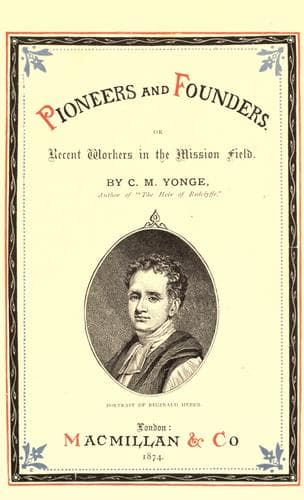
Pioneers and Founders: or, Recent Workers in the Mission fieldYonge, Charlotte M. (Charlotte Mary)
History
Pioneers and Founders: or, Recent Workers in the Mission field
Yonge, Charlotte M. (Charlotte Mary)
Missionaries
"Adieu, dear Heber, life and health!
And store of literary wealth."
Just as Reginald was finishing his prize poem, Scott was on a tour
through England, and breakfasted at Richard Heber's rooms at Oxford, when
on the way to lionize Blenheim. The young brother's poem was brought
forward and read aloud, and Scott's opinion was anxiously looked for. It
was thoroughly favourable, "but," said Scott, "you have missed one
striking circumstance in your account of the building of the Temple, that
no tools were used in its erection."
Before the party broke up the lines had been added:
"No workman's steel, no ponderous axes rung;
Like some tall palm the noiseless fabric sprung;
Majestic silence--"
The prose essay on "Common Sense" was first recited from the rostrum in
the Sheldonian theatre, and Wilson always remembered the hearty applause
of the young man who sat waiting his turn. But the effect of the
recitation of "Palestine" was entirely unrivalled on that as on any other
occasion. Reginald Heber,--a graceful, fine-looking, rather pale young
man of twenty,--with his younger brother Thomas beside him as prompter,
stood in the rostrum, and commenced in a clear, beautiful, melancholy
voice, with perfect declamation, which overcame all the stir and
tumultuous restlessness of the audience by the power and sweetness of
words and action:
"Reft of thy sons, amid thy foes forlorn,
Mourn, widow'd queen; forgotten Zion, mourn.
Is this thy place, sad city, this thy throne,
Where the wild desert rears its craggy stone;
While suns unblest their angry lustre fling,
And wayworn pilgrims seek the scanty spring?"
On flowed the harmonious lines, looking back to the call of the Chosen,
the victory of Joshua, the glory of Solomon, the hidden glory of the
Greater than Solomon, the crime of crimes, the destruction, the renewal
by the Empress Helena, the Crusades, and after a tribute (excusable at
the time of excitement) to Sir Sidney Smith's defence of Acre, gradually
rising to a magnificent description of the heavenly Jerusalem.
"Ten thousand harps attune the mystic throng,
Ten thousand thousand saints the strain prolong.
'Worthy the Lamb, omnipotent to save!
Who died, Who lives triumphant o'er the grave."
The enthusiasm, the hush, the feeling, the acclamations have ever since
been remembered at Oxford as unequalled. Heber's parents were both
present, and his mother, repairing at once in her joy to his rooms, found
him kneeling by his bedside, laying the burthen of honour and success
upon his God. His father, recently recovered from illness, was so
overcome and shaken by the pressure of the throng and the thunder of
applause as never entirely to recover the fatigue, and he died eight
months later, early in 1804.
Public-domain text, read in full here on John Shaqi.
Reviews
Reviews
No reviews yet
Be the first to share your thoughts on this work.
Elsewhere in the archive
Join the Discussion
Join the discussion
Sign in to leave a comment or review.
Sign InorCreate an account