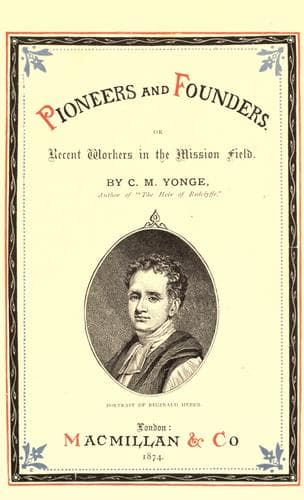
Pioneers and Founders: or, Recent Workers in the Mission fieldYonge, Charlotte M. (Charlotte Mary)
History
Pioneers and Founders: or, Recent Workers in the Mission field
Yonge, Charlotte M. (Charlotte Mary)
Missionaries
He was meantime rising in influence and station,--Canon of St. Asaph,
Preacher at Lincoln's Inn, Select Preacher before the University. He was
beloved by all ranks: by the poor for his boundless charity and sympathy;
and by his equals, not only for these qualities, but for his sunny
temper, bright wit, and playfulness, which showed in his conversation,
his letters, and in many a droll, elegant, and scholarly _jeu d'esprit_,
thrown off by a mind that could do nothing without gracefulness. All
this prosperity was alloyed only by such domestic sorrow as might be
fitly termed gentle chastening. The death of his next brother, Thomas,
who had acted as his curate, was a severe loss to him; and in the desire
to make every affliction a stepping-stone in Christian progress, he
began, from that date, a custom of composing a short collect-like prayer,
veiled in Latin, on every marked occurrence in his life. The next
occasion was, after several years of marriage, the birth of a little
daughter, whom (in his own words) "he had the pleasure of seeing and
caressing for six months," ere she faded away, and died just before the
Christmas of 1817. He never could speak of her without tears, and (his
wife tells us) ever after added to his private prayers a petition to be
worthy to rejoin his "sinless child." His grief and his faith further
found voice in the hymn, each verse of which begins with "Thou art gone
to the grave, but we will not deplore thee," and which finishes--
"Thou art gone to the grave, but we will not deplore thee,
Whose God was thy ransom, thy Guardian and Guide.
He gave thee, He took thee, and He will restore thee,
And death has no sting, for the Saviour has died."
Such had been the training of Reginald Heber, through the pleasant paths
of successful scholarship and literature, and of well-beneficed country
pastorship; a life perilous to spirituality and earnestness, but which he
kept full of the salt of piety, charity and unwearied activity as parish
priest, and as one of the voices of the Church. Such had been his life
up to 1822, when, on the tidings of the death of Dr. Middleton, Bishop of
Calcutta, his friend Charles Williams Wynn, President of the Board of
Commissioners for the affairs of India, offered him the appointment.
Public-domain text, read in full here on John Shaqi.
Reviews
Reviews
No reviews yet
Be the first to share your thoughts on this work.
Elsewhere in the archive
Join the Discussion
Join the discussion
Sign in to leave a comment or review.
Sign InorCreate an account