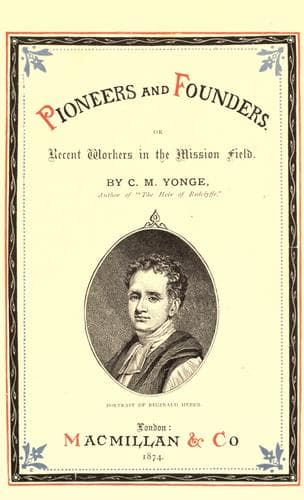
Pioneers and Founders: or, Recent Workers in the Mission fieldYonge, Charlotte M. (Charlotte Mary)
History
Pioneers and Founders: or, Recent Workers in the Mission field
Yonge, Charlotte M. (Charlotte Mary)
Missionaries
To a man of his present position, talents, and prospects at home, the
preferment was not advantageous: the income, with the heavy attendant
expenses, would very little increase his means; the promotion threw him
out of the chances of the like at home; and the labour and toil of the
half-constituted and enormous diocese, the needful struggles with English
irreligion and native heathenism, and the perils of climate, offered a
trying exchange for all that had made life delightful at Hodnet Rectory.
A second little daughter too, whom he could not of course look to
educating in India, rendered the decision more trying. But in his own
peculiarly calm and simple way, he wrote: "I really should not think
myself justified in declining a situation of so great usefulness, and for
which, without vanity, I think myself not ill adapted, either from a love
for the society and friendship of England, or from a hope, which may
never be realized, of being some time or other in a situation of more
importance at home." At first, however, the fear for the child's health
induced him to decline, but only if anyone else equally suitable could be
found; and finally he accepted it, with apparent coolness, veiling the
deep spirit of zeal and enthusiasm that glowed within. It was not the
ardent vehemence that enables some to follow their inward call,
overcoming all obstacles, but it was calm obedience to a call from
without. "After all," he wrote, "I hope I am not enthusiastic in
thinking that a clergyman is, like a soldier or a sailor, bound to go on
any service, however remote or undesirable, where the course of his duty
leads him, and my destiny (though there are some circumstances attending
it which make my heart ache) has many, very many, advantages in an
extended sphere of professional activity, in the indulgence of literary
curiosity, and, what to me has many charms, the opportunity of seeing
nature in some of its wildest and most majestic features."
In the spring of 1823, he took leave of Hodnet, amid the tears of his
parishioners; and on the 18th of May preached his last sermon in
Lincoln's Inn chapel, on the Atonement. On coming out, one of the most
leading men among the Wesleyan Methodists could only express his feelings
by exclaiming, "Thank God for that man! Thank God for that man!"
It is striking to find him in the full pressure of business, while
preparing in London for his consecration and his voyage, making time for
a letter to one of the Hodnet farmers, to warn him against habits of
drunkenness, hoping that it would dwell with him "as a voice from the
dead." On the 1st of June, 1823, Reginald Heber was consecrated at
Lambeth, and on the 10th sailed for India! He made several sketches
along the southern coast, under one of which he wrote:--
"And we must have danger, and fever, and pain,
Ere we look on the white rocks of Albion again."
Public-domain text, read in full here on John Shaqi.
Reviews
Reviews
No reviews yet
Be the first to share your thoughts on this work.
Elsewhere in the archive
Join the Discussion
Join the discussion
Sign in to leave a comment or review.
Sign InorCreate an account