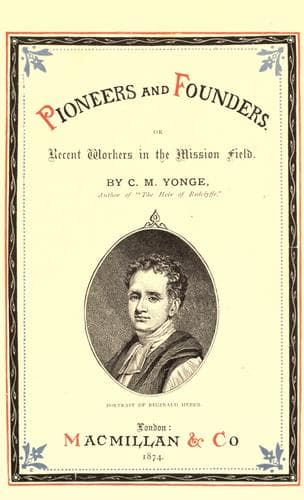
Pioneers and Founders: or, Recent Workers in the Mission fieldYonge, Charlotte M. (Charlotte Mary)
History
Pioneers and Founders: or, Recent Workers in the Mission field
Yonge, Charlotte M. (Charlotte Mary)
Missionaries
The Commissioner had built a church, the walls of teak slabs, and the
pillars each a single teak-tree, and it was ready for consecration. After
this and a confirmation, the Bishop went on his way to Ceylon, and then
to the Madras Presidency, where he had already had a long correspondence
with the pastors of the Christian congregations on the question of caste.
Things had not prospered of late; and, to the dismay of the Bishop, he
found that, in the course of the last year, 168 Christians had fallen
back to heathenism, where, not having broken their caste, they could
still be received and find a place. The truth was that, though caste
might appear only a distinction of mere social rank, it was derived from
a pagan superstition, and was a stronghold of heathenism. Schwartz was
all his life trying to make it wear and die out, lest the violent
renunciation should be too much for his converts' faith. But his
successors had allowed the feeling to retrograde; and Bishop Wilson found
separate services, sides of the church allotted to the high and low
castes, and the most unchristian distinctions made between them. He
decided that toleration of the prejudice was only doing harm, and issued
orders that henceforth catechumens preparing for baptism, confirmation,
or communion, should be called on to renounce caste as a condition of
admittance; and that, though the adult communicants should be gently
dealt with, there should be no recognition of the distinction in the
places in church, in the order of administering the Holy Communion, in
marriages or processions, and that differences of food or dress, or marks
on the forehead, should be discontinued. The clergy were in
consternation, and made an appeal before they published the Bishop's
letter to their flocks; but they found his mind made up, and yielded. The
lesser stations complied without much difficulty; but at Trichinopoly,
Vepery, and Tanjore, there were many Soodras, the soldier-caste,
professing to have come from Brahma's shoulders, and second only to the
Brahmins. They were desperately offended. At Trichinopoly, only seven
Soodra families continued to attend the services, although the seceders
behaved quietly, and offered no insults either to the clergy or the
pariahs. At Vepery, on the reading of the Bishop's letter, the whole
Soodra population walked out _en masse_, except one catechist, who joined
them afterwards. They then drew up a paper, declaring that they would
not yield, and would neither come to church nor send their children to
school, unless they continued to be distinguished; and they set up a
service of their own in a chapel lent them by a missionary belonging to
the London Society. He was, however, reprimanded for this by the
committee which employed him at Madras, and the chapel was withdrawn;
upon which the Soodras remained without any public worship whatever for
five months, when the catechists and schoolmasters came forward and
Public-domain text, read in full here on John Shaqi.
Reviews
Reviews
No reviews yet
Be the first to share your thoughts on this work.
Elsewhere in the archive
Join the Discussion
Join the discussion
Sign in to leave a comment or review.
Sign InorCreate an account