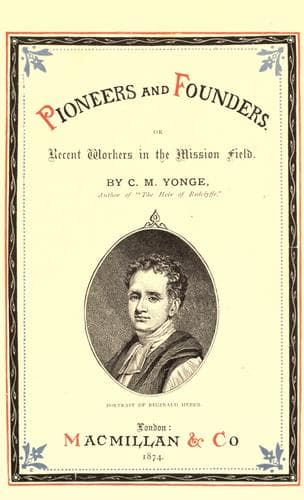
Pioneers and Founders: or, Recent Workers in the Mission fieldYonge, Charlotte M. (Charlotte Mary)
History
Pioneers and Founders: or, Recent Workers in the Mission field
Yonge, Charlotte M. (Charlotte Mary)
Missionaries
acknowledged their pride and contumacy, the children dropped into the
schools, and the grown-up people, one by one, returned to church, but in
their own way.
At Tanjore, the contest was a much harder one. Serfojee had died in
1834, and the son whom Bishop Heber had vainly tried to obtain for
education was one of the ordinary specimens of indolent, useless rajahs,
enjoying ease and display under British protection; but the Mission had
gone on thriving as to numbers, though scarcely as to earnestness or
energy; and the Christians numbered 7,000, with 107 catechists and four
native clergy, under the management of Mr. Kohloff, almost the last of
Schwartz's fellow-workers. The Bishop's letter was read aloud by him,
after the sermon, on the 10th of November, 1833. There was an immediate
clamour of all the Soodras, who would not be hushed by being reminded
that they were in church, and, while Mr. Kohloff was being assisted from
the pulpit, gathered round his wife and insulted her.
Letters passed between the Soodras and the missionaries. There was no
denial that the Bishop's command was right in itself; but an immense
variety of excuses were offered for not complying with it, and only one
of the four priests consented,--Nyanapracasem, an old man of eighty, who
may be remembered as one of Schwartz's earliest converts, and of the four
priests ordained by the Lutherans,--with three catechists, and ten of the
general body; all the others remained in a state of secession. When the
first death took place among them, Nyanapracasem, the one conforming
priest, was appointed to read the funeral service; but he fell sick, and
the only substitute available on the spot was a low-caste catechist, a
very respectable man, but whom the Soodras silenced with threats,
employing one of their own people in his stead. Next time, they borrowed
the Roman Catholic burial-ground, and services were carried on, on
Sunday, by one of the dissentient priests, but marriages were celebrated
in the heathen fashion, and there was evidently a strong disposition to
form a schism, which the reckless, easy, self-willed conduct of the
Soodras showed would be Christianity only in name. There had even been
an appeal to the Governor-General, and the Bishop felt the whole tone of
Christianity in India to be at stake.
It was in the height of this crisis that his journey to Madras was made
in the track of Bishop Heber. Twice he preached at Vepery, and the
Soodras attended; but he asked no questions, and let them place
themselves as they chose, and take precedence, intending to fight out the
question at Tanjore.
Public-domain text, read in full here on John Shaqi.
Reviews
Reviews
No reviews yet
Be the first to share your thoughts on this work.
Elsewhere in the archive
Join the Discussion
Join the discussion
Sign in to leave a comment or review.
Sign InorCreate an account