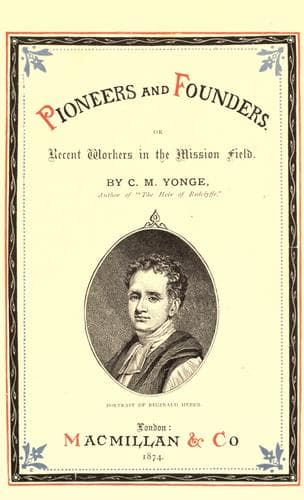
Pioneers and Founders: or, Recent Workers in the Mission fieldYonge, Charlotte M. (Charlotte Mary)
History
Pioneers and Founders: or, Recent Workers in the Mission field
Yonge, Charlotte M. (Charlotte Mary)
Missionaries
After this there were a great number of private conferences. People came
and owned that they had been very unhappy; religion had died in their
hearts, and they had had no peace; but their wives were the great
objectors--they feared whether they should marry their daughters, &c. &c.
The two priests especially saw the badness of their standing-ground, but
they should lose respect, they said. No Pariah seems to have been in
holy orders, but if a Pariah catechist visited a sick person, he was not
allowed to come under the roof, and the patient was carried out into the
verandah. And then came a rather stormy conference with about 150
Soodras, which occupied two days, since every sentence had to pass
through an interpreter. The objections were various, but as a body the
resistance continued, and it was only individuals that came over; some of
these, however, did, and it was so clear from all that had passed that to
permit the distinctions was but a truckling to heathenism, that the
Bishop was more than ever resolved on firmness. Two of the priests had
conformed, and the Christianity of those who would not do so was plainly
not worth having.
There was some polite intercourse with Serfojee's son, whose taste was
visible in the alteration of a fine statue of his father by Flaxman, from
which the white marble turban had been removed to substitute a coloured
one, with black feathers and tassels. In him the family has become
extinct, since he only left a daughter, and the adoption of a son, after
the old Hindoo fashion, has not been permitted by Government.
Thence, Bishop Wilson proceeded towards Trichinopoly. He encamped, by
the way, at a place called Muttooputty, a large station on the Coleroon
river, where the way had been so prepared for him that there was a grand
throng of native Christians, untroubled about caste, and he was obliged
literally to lengthen the cords and strengthen the stakes of the large
tent used as a chapel. It was one of the memorable days of joy that come
now and then to support the laborious spirit of the faithful servant.
"One such day as we have just passed is worth years of common service."
At Trichinopoly, with the deepest sense of reverence, he visited the
scene of Heber's death, ministered at the same altar, and preached from
the same pulpit, after an interval of nine years.
Here, his mode of dealing with the caste-question was thus: When he came
robed into the church, he saw groups of natives standing about, instead
of placing themselves like the others of the congregation. He went up to
two, led them to seats, and his chaplain following, did the same; the
rest were seated in like manner without resistance.
Public-domain text, read in full here on John Shaqi.
Reviews
Reviews
No reviews yet
Be the first to share your thoughts on this work.
Elsewhere in the archive
Join the Discussion
Join the discussion
Sign in to leave a comment or review.
Sign InorCreate an account