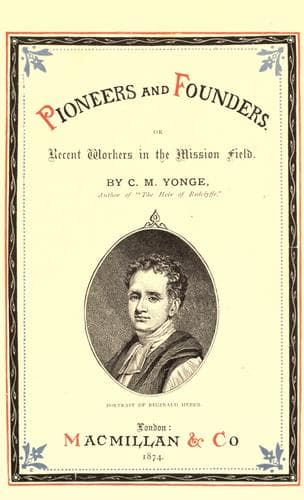
Pioneers and Founders: or, Recent Workers in the Mission fieldYonge, Charlotte M. (Charlotte Mary)
History
Pioneers and Founders: or, Recent Workers in the Mission field
Yonge, Charlotte M. (Charlotte Mary)
Missionaries
When the Celebration took place, the Bishop had given directions as to
the order of things. First, a Soodra catechist communicated, then two
Pariah catechists, then an English gentleman, next a Pariah, then two
Eurasians; and thus without distinction, 147 communicated. The barrier
was broken down, and the nucleus of a church without caste was formed.
This presidency of Madras was immediately after formed into a separate
see, and given to Daniel Corrie, the friend of Martyn, while Dr. Thomas
Carr became Bishop of Bombay.
On Wilson's return to Tanjore he found an increasing though still small
number had conformed, and before he left the place there were hopes of
larger numbers. On his way back to Calcutta, he visited the horrible
pagoda of Juggernaut (properly Jaghanatha, Lord of the World), which was
still the centre of worship and pilgrimage; and though the
self-immolation of the pilgrims beneath the car had been prohibited, yet
the Company's Government still fancied themselves justified in receiving
a toll from the visitors to this shrine of cruelty and all uncleanness,
up to 1839, when the disgrace was done away by Lord Auckland.
In the year 1836 another journey was made, first to Bombay and then
further into the interior, to many places, never visited by a bishop
before, and with no chaplain or anything to keep up the sense of
religion. At Aurungabad, the utter ignorance of the English officers was
appalling. The old Colonel-commandant had not heard a sermon for twenty
years, and thought every sentence on the text, "Walk in love," was a
personal attack on himself. He refused to attend another service, or to
bid the Bishop farewell! And when the Holy Communion was celebrated,
nobody knew what the offertory meant, and scarcely any one was prepared
to respond.
Yet in contrast to these English, a small band of Hindoos, four men, six
women, and five children, presented themselves, asking permission to join
in the service, and to have their children baptized. They had been once
Roman Catholics, but an old Dutchwoman from Ceylon had taught them most
of what they knew; and they had a Hindostanee prayer-book, whence they
held a service every Sunday, but leaving out the Absolution and
Benediction, which they rightly perceived to be priestly functions. Two
of them were servants to an English officer, and they were all nearly
related. They were perfectly respectable and trustworthy, and looked
well dressed and intelligent. The Bishop tried to bring about an
application from the Company to the Nizam, to defray the expenses of an
occasional visit from a chaplain to the Christian officers and residents
in his employ, but he was answered that "it would form a dangerous
precedent."
Public-domain text, read in full here on John Shaqi.
Reviews
Reviews
No reviews yet
Be the first to share your thoughts on this work.
Elsewhere in the archive
Join the Discussion
Join the discussion
Sign in to leave a comment or review.
Sign InorCreate an account