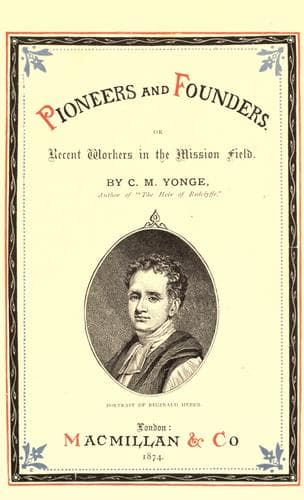
Pioneers and Founders: or, Recent Workers in the Mission fieldYonge, Charlotte M. (Charlotte Mary)
History
Pioneers and Founders: or, Recent Workers in the Mission field
Yonge, Charlotte M. (Charlotte Mary)
Missionaries
The next stage was Delhi, where a very interesting interview awaited him.
An officer of Anglo-Indian birth, James Skinner by name, who had raised
and commanded a capital body of light horse, had twenty years before
entered Delhi with a conquering army, and, gazing on the countless domes
and minarets, vowed that if ever he should be able, he would build an
English church to raise its cross among them. He had persevered, though
the cost far exceeded the estimate, and though the failure of houses of
business had greatly lessened his means; and now he came, a tall, stout,
dark man of fifty-six, in a uniform of blue, silver, and steel, a helmet
on his head and a red ribbon on his breast, to beg for consecration for
his church. His sons were Christians, but his wife was a Mahometan,
though, he said with tears, that "for thirty years a better wife no man
ever had."
The church was of Greek architecture, shaped as a Greek cross, with
porticoes with flights of steps at each extremity except the east, which
formed the chancel, and at the intersection was a dome and cupola. It
was paved with marble, and the whole effect was beautiful. After the
consecration a confirmation followed, and the first to receive the
apostolic rite were the noble old Colonel himself and his three sons.
Twenty years later this fine building was filled with dying men, and
shared in the horrors of the siege of Delhi; but it has now returned to
its rightful use, and as a church of martyrs.
Indeed, all the places that the Bishop visited in this excursion have
since been associated with the Mutiny. Cawnpore was not much more
satisfactory than when Heber had visited it; an irreligious commandant
and a dissipated regiment had done much harm; and an imprudent letter of
one of the chaplains had led to a quarrel, in which the clergyman
unfortunately put himself in the wrong. Happily, a new commanding
officer and better conducted regiment had replaced the first, and the ill-
feeling was so entirely removed that the Bishop wrote, "Never did I enter
a station with such despondency, nor leave one with so much joy." And
thus he prepared Cawnpore for that which was in store for it!
Public-domain text, read in full here on John Shaqi.
Reviews
Reviews
No reviews yet
Be the first to share your thoughts on this work.
Elsewhere in the archive
Join the Discussion
Join the discussion
Sign in to leave a comment or review.
Sign InorCreate an account