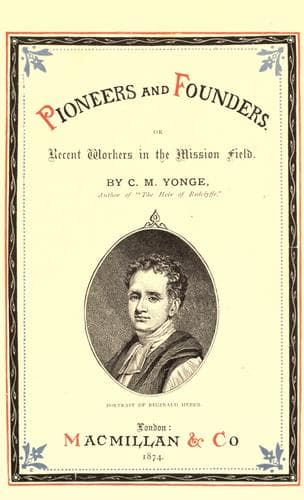
Pioneers and Founders: or, Recent Workers in the Mission fieldYonge, Charlotte M. (Charlotte Mary)
History
Pioneers and Founders: or, Recent Workers in the Mission field
Yonge, Charlotte M. (Charlotte Mary)
Missionaries
The next step was into the Bengal presidency, always with the same kind
of adventures; quaint civilities of the presentation of flowery garlands
bedecking the neck and arms, given by the native princes, with a
sprinkling of rose-water, and sometimes an anointing with oil; and then
an endeavour to stir into Christian life the neglected English military
and civil officers stationed in their dominions.
One of these, a gentleman of good birth and repute, actually went on
smoking and gurgling his hookah when the Bishop was beginning family
prayers, apparently with no more perception that it was anything that
concerned him than if he had seen a Mahometan turning to Mecca, or a
Parsee saluting the rising sun. Indeed many of these Company's servants
had been sent out when fourteen or fifteen years old; and, if in a remote
station, had been left without anything external whatever to remind them
of Christianity.
This journey extended to the Himalayas, where the Bishop had four months'
repose at Simlah, then in its infancy as a resort for wearied East
Indians; and on his descent from thence, his first halting-place was
Kurnaul, where he found the church in a state of efficiency, owing, in
great part, to an officer whose conversion to a religious life had been
very remarkable. Once, when in a large party, where gambling was going
on to a reckless extent, he saw one of the players take out a hideous
little black figure, supposed to represent the devil, to which he
addressed himself with a mixture of entreaties and threats, involving
such blasphemy that this officer, utterly horrified, withdrew from the
company, spent the night in tears and prayers, and from that time became
a religious man. There was also an active chaplain, a large church, and
a bungalow, built by the soldiers of an English regiment, the centre part
arranged for service, and the surrounding verandah partitioned into
little cells, where the soldiers could retire for private prayer or
reading. It was called St. John's Chapel, and was in the hands of the
chaplain. Here the Bishop remained for two Sundays, and ordained Anund
Musseeh, who had been fifteen years a Christian, and had been known to
Bishop Heber. The difficulty in his case was the rule not to ordain a
person who had a heathen family, since he had not been able to convert
his wife. His excellence outweighed the objection, and he was the first
Brahmin who received holy orders from an English bishop; but in after-
times the heathen influence at home told upon him; and this failure
perhaps rendered Bishop Daniel Wilson somewhat over-cautious and backward
in ordaining a native ministry.
Public-domain text, read in full here on John Shaqi.
Reviews
Reviews
No reviews yet
Be the first to share your thoughts on this work.
Elsewhere in the archive
Join the Discussion
Join the discussion
Sign in to leave a comment or review.
Sign InorCreate an account