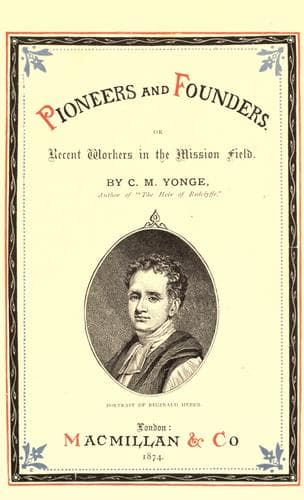
Pioneers and Founders: or, Recent Workers in the Mission fieldYonge, Charlotte M. (Charlotte Mary)
History
Pioneers and Founders: or, Recent Workers in the Mission field
Yonge, Charlotte M. (Charlotte Mary)
Missionaries
He returned to England by the Overland route, and after a short respite
recovered much of his strength, so as to be able to preach in many
churches and appear at numerous meetings; and in a year's time the
vigorous old man was on his way back to his diocese, where he arrived in
time to keep the Christmas of 1846, just two years after he had been
stricken down by fever. In the October of the next year he consecrated
his cathedral, towards which 20,000_l._ had been his own donation, half
towards the building, half towards the endowment. His strength was not
quite what it had been before, but he still had abundant energy, and new
branches of the Church were springing up around him; not only the three
dioceses that had branched from his own in India, but Ceylon had a Bishop
of its own, Australia had five, and the Cape and New Zealand and the Isle
of Hong Kong had each received a Bishop. The principle had come to be
recognized that to send out isolated workers without a head to organize
was a plan that could hardly be reasonably expected to succeed; and in
the long run prosperity has certainly attended the contrary arrangement.
Not to speak of the Divine authority, the action of a body under a
recognized head and superior on the spot must be far readier of
adaptation to circumstances than that of a number of equals, accountable
only to some necessarily half-informed Society at home.
In his 73rd year, just after a visitation tour, it somewhat dismayed
Bishop Wilson to find a letter from the Bishop of London sending him to
consecrate the new church erected by Sir James Brooke, at Sarawak. Few
careers have been more remarkable than that of the truly great man who
subdued Malay piracy, and gained the confidence of the natives of Borneo;
and when the effort of the fourteen weeks' voyage had been made, the
Bishop returned full of joy and hope, and not long after, together with
the Bishops of Madras and Victoria, joined in consecrating the missionary
Bishop of Labuan to the new field of work there opening. On the last
journey of his life he also visited Rangoon, and there consecrated the
church, finding the clergy hard at work and numerous converts.
During the year 1856 he had many attacks of illness, more or less severe;
and in December, in going across the room in haste, he struck himself
against a wooden screen, and was thrown down. His thigh was broken, and
his age was such that great fears for his life were entertained, but he
recovered, and was able to pray with, cheer, and comfort the many anxious
hearts at Calcutta during the dreadful days of the Indian mutiny of 1857,
when the churches he had consecrated were stained with the blood of the
worshippers.
Public-domain text, read in full here on John Shaqi.
Reviews
Reviews
No reviews yet
Be the first to share your thoughts on this work.
Elsewhere in the archive
Join the Discussion
Join the discussion
Sign in to leave a comment or review.
Sign InorCreate an account