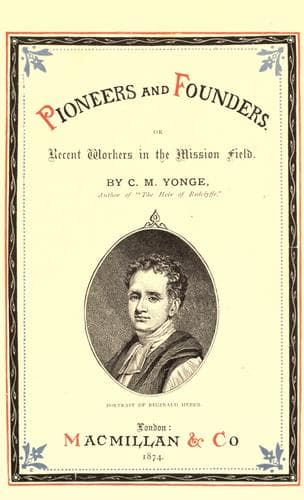
Pioneers and Founders: or, Recent Workers in the Mission fieldYonge, Charlotte M. (Charlotte Mary)
History
Pioneers and Founders: or, Recent Workers in the Mission field
Yonge, Charlotte M. (Charlotte Mary)
Missionaries
The next anxiety was at a spot called the Yellow-wood River, where the
mid-day halt was disturbed by an assembly of natives with a hostile
appearance. Captain Gardiner sent orders to collect the oxen, and in-
span (_i.e._ harness) them as soon as possible, but without appearance of
alarm, and in the meantime he tried to keep the natives occupied. To one
he lent his penknife, and after the man had vainly tried to cut off his
own beard with it, he offered to shave him, lathered him well, and
performed the operation like a true barber, then showed him his face in a
glass. His only disappointment was that the moustache had not been
removed, and as by this time the razor was past work, Captain Gardiner
had to pacify him by assuring him that such was the appearance of many
English warriors (for these were the days when moustaches were confined
to the cavalry). The amusement this excited occupied them nearly long
enough, but hostile murmurs then began to be heard--"One of our chiefs
has been killed by the white men, no more shall enter our country!"
Fearing that an angry word would be fatal, Captain Gardiner asked for a
war-song, promising some tobacco at the conclusion. Accordingly they
danced madly, and shouted at the top of their voices,
"No white man shall drink our milk,
No white man shall eat our children's bread.
Ho-how! ho-how! ho-how!"
But this couplet often repeated seemed to work off their rage; they
accepted the tobacco, and sullenly said the travellers might pass, but
they were the last who should. This was in the Amakosa country, lying
between the Grahamstown settlement and Port Natal, and to the present day
unannexed, though even then there were traders' stations at intervals, so
filthy and wretched as to be little above the huts of the natives. These
Amakosa tribes were such thieves that great vigilance was needed to
prevent property being stolen; but the next tribes, the Amapondas, were
scrupulously honest and friendly to the English. Their chief was found
by Gardiner and Berken dressed in a leopard's skin, sitting in state
under a canopy of shields, trying a rain-maker, who had failed to bring
showers in consequence of not having his dues of cattle delivered to him!
The chief advised them not to proceed, as he said the Zulus were angry
people who would kill them; but they pushed on, though finding that the
journey occupied much longer than they expected, so that provisions
became a difficulty.
Public-domain text, read in full here on John Shaqi.
Reviews
Reviews
No reviews yet
Be the first to share your thoughts on this work.
Elsewhere in the archive
Join the Discussion
Join the discussion
Sign in to leave a comment or review.
Sign InorCreate an account